










BYD’s two-decade investment in semiconductors is giving the Chinese carmaker an advantage as China pushes to reduce its reliance on foreign automotive chips, according to a Digitimes Intelligence report.
Taiwan-based Digitimes said BYD is ahead of carmakers that are only now accelerating in-house chip development in response to supply-chain pressure.
BYD formed its integrated-circuit design team in 2002, initially concentrating on power semiconductors for electric vehicles.
That work later expanded into insulated-gate bipolar transistor (IGBT) and silicon-carbide (SiC) devices, both important for controlling power in electrified vehicles.
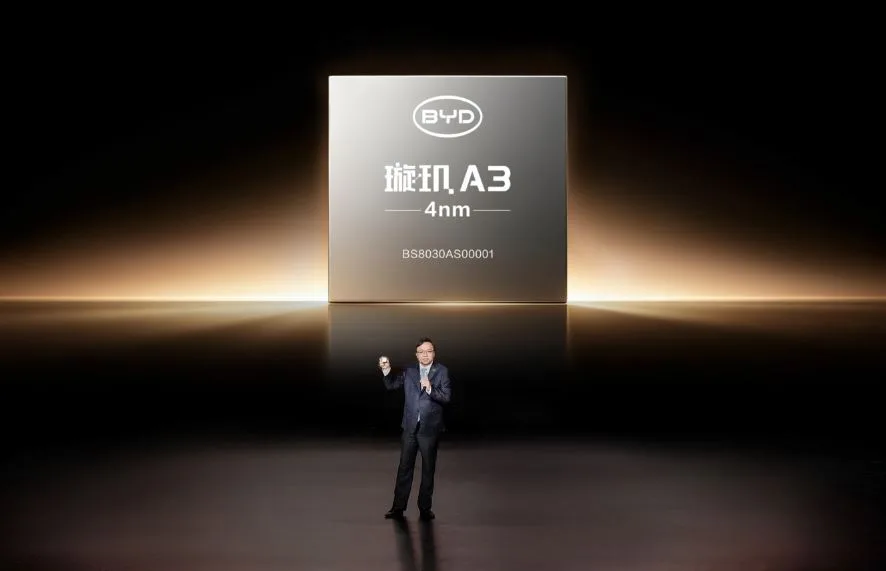
BYD is pushing into more advanced computing chips. Digitimes said its Xuanji A3 smart-driving system-on-chip is moving into scaled production on an automotive-grade 4nm process, shifting the company’s semiconductor focus towards hardware needed for sophisticated driver-assistance systems.
BYD said the A3 is China’s first self-developed automotive-grade 4nm smart-driving chip.
The A3 also shows how far BYD has moved beyond simply buying chips from external suppliers. The company has built what the report describes as an integrated device manufacturer model covering chip design, wafer fabrication and deployment in mass-produced vehicles.
BYD said in May that it has more than 7,000 chip research and development staff, five wafer-manufacturing plants and more than 2,000 chip products. Its automotive-grade portfolio covers 567 products.
China’s semiconductor self-reliance drive is adding urgency. Export restrictions imposed by the US and its allies from 2022 have limited Chinese access to some advanced chips and semiconductor manufacturing equipment.
But a March analysis by the Washington-based Center for Strategic and International Studies found that those restrictions have also accelerated domestic substitution, encouraging Chinese companies to use locally produced chips and equipment.
Chinese carmakers are under greater pressure to secure chip supplies as vehicles use more semiconductors for power management, digital cockpits and advanced driver-assistance systems.
Digitimes senior analyst Jessie Lin also sees potential beyond cars. Many technologies used in intelligent vehicles — including processors, sensors, motors, batteries and control systems — overlap with those required for humanoid robots.
That could give BYD a route into physical AI applications as China expands its robotics industry.
BYD’s long investment in chip design and production therefore gives it greater control over a component becoming more important as cars grow more software- and computing-intensive.
It also reduces exposure to external suppliers, although the Digitimes report does not establish that BYD is fully self-sufficient in automotive semiconductors or free from foreign technology dependencies.