

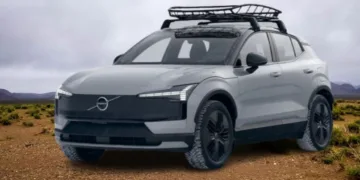







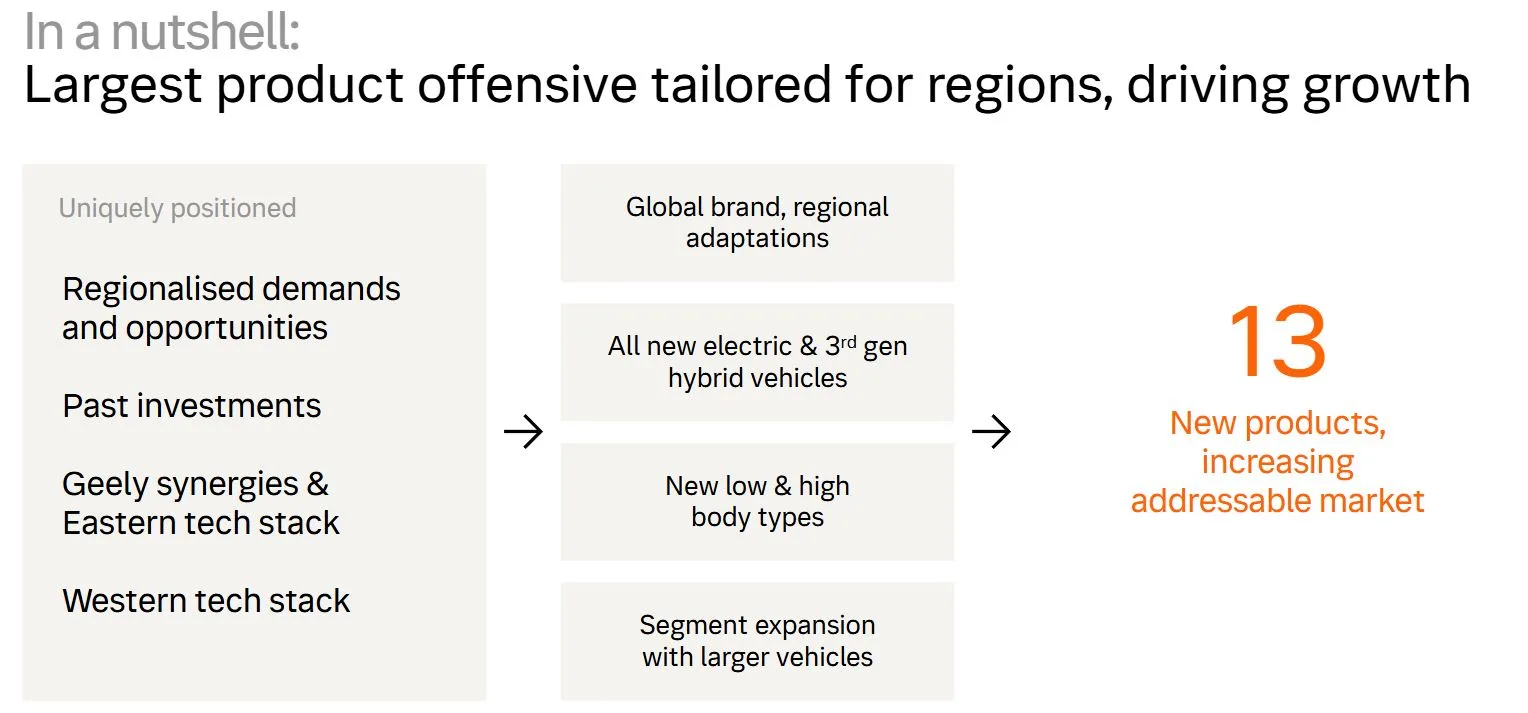
Volvo Cars will launch 13 all-new cars by the end of 2030 in the biggest product programme of its 99-year history, split sharply between Western and Chinese markets.
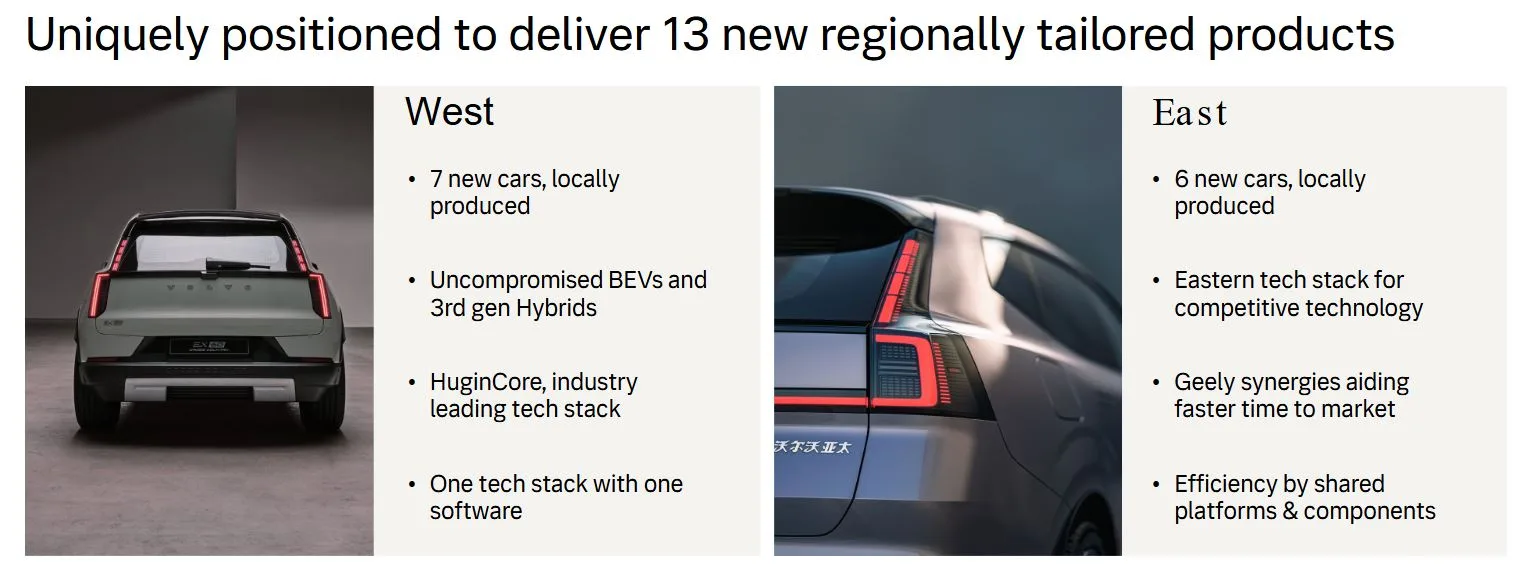
Seven cars are planned for Europe and the US, while six will be developed for China.
The range will mix battery-electric vehicles with what Volvo calls third-generation hybrids. Volvo also wants the expansion to double its market share in the electrified segment while eventually lifting earnings before interest and tax above 8%.
The programme will also take Volvo into new segments and larger vehicle categories.
Volvo plans to use different technology paths for West and East, share far more hardware with Geely, simplify its factory network and spend less on each new programme than during its recent investment peak.
Western-market cars will use Volvo’s HuginCore computing platform and a common software system, with future models based mainly on its SPA2 and SPA3 architectures.
Volvo said all seven new Western-market cars will be produced locally. The strategy deck points to a second SPA3 model for the Košice plant in Slovakia, new lower-bodied models, and a wider US range that will include larger vehicles and mixed propulsion.

Europe is set to have a full battery-electric line-up by 2030, although Volvo will retain third-generation hybrids where demand requires them.
Its next new European model is due in 2027. In the US, Volvo sees room for larger vehicles and a mix of propulsion types, with more local production intended to reduce exposure to tariffs and logistics costs.
China will follow a more distinct route. The six new cars there will be locally produced, using an eastern software and computing system and shared platforms developed with Geely. Volvo said plug-in hybrids remain important in larger Chinese segments, even as the market moves further towards full electrification.
The split means HuginCore for new Western cars and Geely’s electrical and electronic architecture for China-specific models.
Volvo also plans much greater parts sharing across the wider Geely group. Common hardware parts will rise from about 10% today to 30%, while spending with shared suppliers is targeted to exceed 90%.
That scale is expected to cut total material costs by around 5% by the end of the decade, with further savings possible in manufacturing, capital spending and indirect costs.
Volvo said the product expansion will not require another investment surge. Much of the spending on its next-generation technology, plants and platforms has already been made.
The EX60, the first model on SPA3, reached customers in July 2026, giving Volvo a base from which to spread development costs over more vehicles.
Volvo presented the EX60 as an early test of that logic. It said the electric SUV recorded record order intake in its first six months and is already more profitable than the XC60, with the company expecting it to become one of its best-selling and most profitable cars.
Manufacturing will also be simplified. Volvo’s end-of-decade plan envisages reducing the number of dedicated plants from seven to five, with factories increasingly focused on one platform. It also identifies contract-manufacturing opportunities at Ghent in Belgium and Chengdu in China.
The product plan follows Volvo’s 2024 decision to replace its earlier goal of selling only fully electric cars by 2030. Its revised target is for 90% to 100% of global sales to be fully electric or plug-in hybrid by then, leaving room for a small number of mild hybrids if required. Full electrification remains the longer-term aim.
The new plan gives hybrids a defined role through the end of the decade. Volvo has already moved in that direction with updated XC60 and XC90 PHEVs offering up to 200km and 160km of WLTP electric range respectively.
The sales process is changing too. Volvo wants fewer variants, clearer online pricing and faster access to pre-configured cars.
Its wider ownership package will include its Care offer, Volvo ID, over-the-air upgrades and software services, including Google Gemini.
Chief executive Håkan Samuelsson said Volvo showrooms would look very different by 2030.