









Global electric-vehicle sales reached an all-time monthly high in September 2025, with 2.1 million units sold, according to Rho Motion, a Benchmark Mineral Intelligence company.
The milestone was driven by incentives, seasonal factors and model availability across major markets. Year to date, sales total 14.7 million, up 26% from the same period in 2024.
Rho Motion’s snapshot for January–September 2025 shows China at 9.0 million (+24%), Europe 3.0 million (+32%), North America 1.5 million (+11%) and the rest of the world 1.2 million (+48%).
China remained the growth engine, delivering about 1.3 million sales in September.
Battery-electric vehicles (BEVs) rose 28% year on year to just over 0.8 million units, while plug-in hybrids (including range-extended EVs) dipped 2% to roughly 0.47 million.
Nearly nine million EVs were sold in the first nine months, a 24% year-to-date increase that underlines China’s status as the world’s largest and most mature EV market.

Europe posted a regional record with 427,000 sales in September, up 36% year on year and 55% month on month. In the UK, demand peaked with seasonally strong September registrations and the Electric Car Grant introduced in July.
BEV sales rose by around 30% year on year, while plug-in hybrids climbed by almost 60%. Germany is preparing a fresh push in 2026 after approving a €3 billion incentive package aimed at low- and middle-income households through purchase and leasing support, replacing subsidies that ended in December 2023.
Italy and Spain continued to benefit from national schemes, with Italy’s market expanding by roughly two-thirds and Spain more than doubling year on year.
North America saw the United States set a second consecutive monthly high as buyers rushed to secure federal incentives that expired on 30 September.
Sales were 66% higher year on year, helped by the 30D tax credit available to around 20 BEV models and the 45W credit that supported competitive leasing. A slowdown is expected in the fourth quarter as incentives lapse.
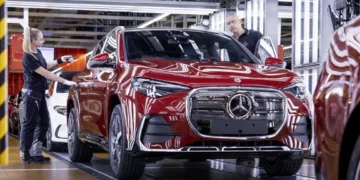
Manufacturers are already adjusting: Hyundai has cut prices; General Motors suspended one shift at its Spring Hill, Tennessee, plant; Mercedes-Benz paused production of four EV models; Volkswagen will halt ID.4 production in Tennessee at the end of October; and Nissan has cancelled plans to produce EVs in the United States.
The figures point to a market still expanding globally but increasingly sensitive to policy changes, with Europe preparing renewed support and the US bracing for a post-incentive correction.