








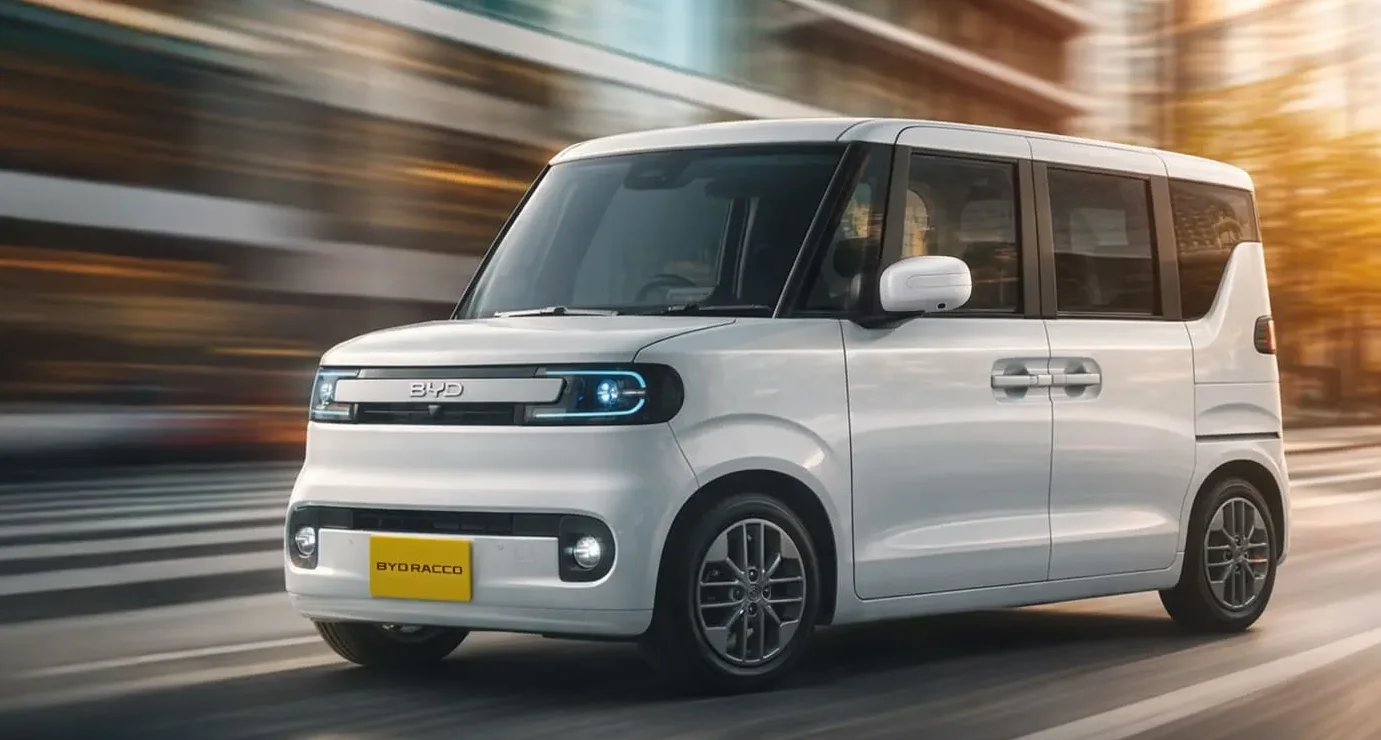
BYD has launched the Racco electric kei car in Japan, with three variants priced from ¥2.145 million (RM53,500) including consumption tax.
Sales began immediately through BYD’s authorised Japanese dealer network.
The Racco 200 opens the range, followed by the Racco 300Plus at ¥2.398 million (RM59,900) and the Racco 300Premium at ¥2.497 million (RM62,300).
All three qualify for Japan’s ¥150,000 (RM3,740) Clean Energy Vehicle subsidy.
Reuters reported that BYD is targeting 10,000 Racco orders by the end of 2026. The target is ambitious: the Chinese carmaker had sold just over 7,400 vehicles in Japan between entering the passenger-car market in early 2023 and the end of 2025.
The Racco was developed specifically around Japan’s kei-car regulations. It measures 3,395 mm long, 1,475 mm wide and 1,800 mm tall, with a 2,520 mm wheelbase. The four-seater uses a front-mounted motor producing 47 kW, equivalent to 64 PS, and 160 Nm, driving the front wheels.

Two lithium iron phosphate Blade Battery sizes are offered. The Racco 200 has a 22.40 kWh pack and a 210 km range under Japan’s WLTC test cycle. Both 300 versions use a 35.84 kWh battery and are rated at 320 km.
Its boxy super-tall body follows the format favoured by Japanese buyers.
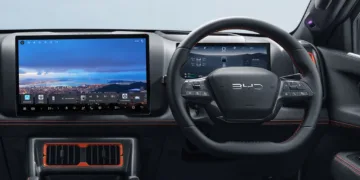
Powered sliding doors are fitted on both sides, while the equipment list includes a 10.1-inch touchscreen, Apple CarPlay, Android Auto, an around-view camera and a child-presence detection system. Hands-free operation is available for the sliding doors.
Underneath, the Racco uses a version of BYD’s e-Platform 3.0 with Cell-to-Body construction. A new X-PACK arrangement places the battery, control units and several power-electronics components into one integrated assembly.

BYD said this frees more room for occupants and crash-energy absorption within the kei car’s tightly controlled dimensions.
The general vehicle warranty runs for six years or 150,000 km. High-voltage components and the traction battery are covered for eight years or 160,000 km. An optional ¥18,000 (RM450) extension increases the battery-capacity warranty to 10 years or 200,000 km.
BYD’s starting price is lower than the Nissan Sakura before subsidies and tax, according to Reuters. However, the Sakura remains cheaper after Japan’s government incentives are applied because it receives a larger subsidy.
The Racco gives BYD access to a segment that accounts for roughly a third of Japanese new-car sales. Whether buyers accept a Chinese badge in a class dominated by local brands will determine whether its aggressive target is realistic.