










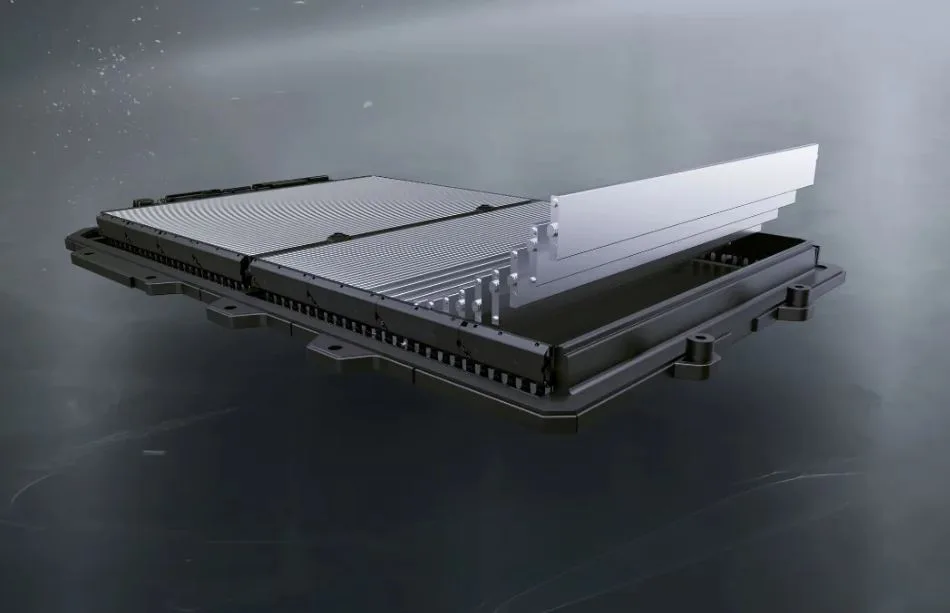
A recent BYD patent application outlines a stationary battery cabinet in which the cells are cooled by being immersed directly in dielectric fluid, while all high-voltage and control hardware is kept in a dry section of the enclosure.
Published on Oct 5 by China’s patent office (CNIPA), the document describes an energy-storage cabinet split into two physically separated zones: one filled with non-conductive coolant that surrounds the modules, and another that remains free of liquid and houses the electrical gear.
The filing, submitted in March 2025 and still under examination, is pitched as an invention patent for battery cabinets and related storage equipment rather than a vehicle pack.
Instead of routing cables and signal wires through the bottom or sides of the wet chamber, the design brings those connections up through the top of the liquid compartment before they pass into the dry area.
By placing the sealing interfaces higher in the fluid column, the patent argues that hydrostatic pressure on the seals is reduced, which in turn should lower the likelihood of coolant leaks at those junctions.
This approach contrasts with most current large-format storage systems, including BYD’s own MC Cube / MC Cube-T and CATL’s EnerOne and EnerC lines, which rely on indirect liquid cooling via cold plates or channels that never fully submerge the modules.
The application specifies dielectric fluids such as hydrocarbon- or ester-based formulations, making it clear that the concept is intended for stationary installations where the modules can sit in a bath of insulating liquid.
There is no mention of passenger cars, and BYD has given no indication that the architecture is scheduled for commercial production.