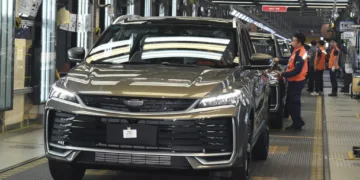


Xpeng’s flying-car arm, Aridge, has produced the first unit of its “Land Aircraft Carrier” at a new factory in Guangzhou’s Huangpu district, a milestone the company says completes the world’s first mass-production line for flying cars.
Trial builds will now support test flights and process validation ahead of deliveries targeted from 2026.
The 120,000-square-metre site is dedicated to the aircraft portion of the modular system and starts with annual capacity of 5,000 units, rising to 10,000 at full tilt.
At maximum output, Aridge claims one aircraft can come off the line every 30 minutes.
Branded previously as Xpeng Aeroht, Aridge is majority-owned by Xpeng and was formally set up in 2020 after years of advanced projects.
The company has pursued two tracks: pure eVTOL models and the modular “Land Aircraft Carrier”, which pairs a detachable flying module with a ground “mother” vehicle.

Executives have guided to mass production and delivery by 2026 with a price ceiling of 2 million yuan (RM1.2mil).
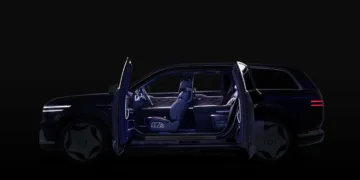
Aridge described the ground vehicle as a three-axle, six-wheel off-roader with four seats, rear-wheel steering and a silicon-carbide 800-V extended-range platform claiming more than 1,000km on the CLTC cycle.
The two-seat, four-rotor flying module supports one-touch take-off/landing, autonomous navigation and 30–80% fast-charging in about 18 minutes, with up to five or six short missions per full charge and fuel tank.
Regulatory work has been under way for more than a year: China’s aviation regulator accepted Aridge’s type-certificate application for the flying module in March 2024 and its production-certificate application in May, paving the way for pilot operations and wider flight testing.

Internationally, the company has been courting early adopters in the Middle East after a public manned demonstration in Dubai and said it has framework agreements for an initial batch of 600 units, with regional sales aimed at 2027.
If Aridge hits its timetable, 2026 could be the year flying-car projects move from air-show curiosities to low-volume series production.
The bigger test would be certification, safety and real-world use cases — well beyond the factory gates.