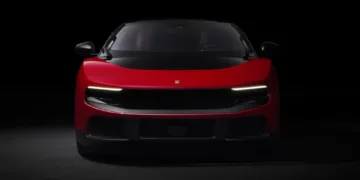




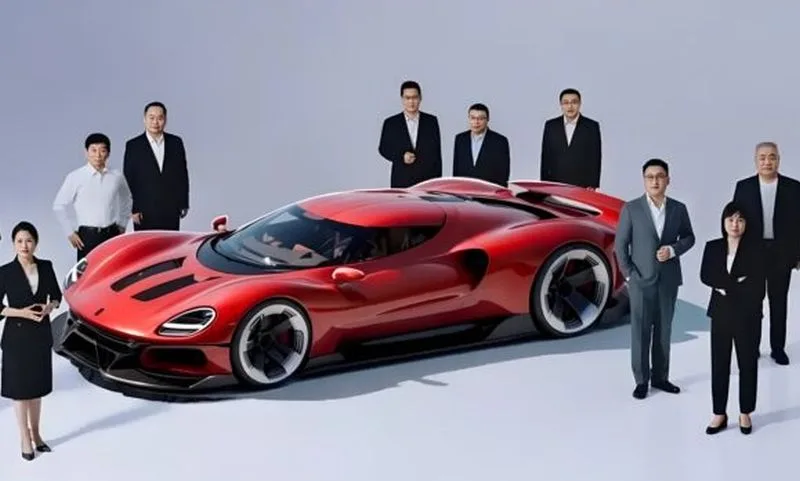
Great Wall Motor is about to do something audacious: build a proper supercar.
Not a fast SUV with a coupe roofline. Not a limited-run concept that never sees production. An actual mid-engine, carbon-tubbed, Ferrari-fighting exotic.
Chairman Wei Jianjun let the news slip during an appearance on China Central Television’s “Dialogue” programme last week, confirming what insiders have whispered about for months. The car has been cooking for five years, and GWM plans to launch it by the end of 2026.
It sounds absurd until you look at what Chinese automakers have already pulled off in the EV space. They’ve undercut Tesla on price while matching range and tech. Now they want to do the same thing to Maranello.
What we know so far
GWM isn’t saying much officially, but the outline is clear enough.
The supercar will use a 4.0-litre twin-turbo V8 — an engine the company has already developed — paired with electric motors in a plug-in hybrid setup. Think Ferrari SF90 Stradale, which is apparently the benchmark GWM is chasing.
The chassis? Carbon fibre monocoque with a mid-engine layout. All the right ingredients for something genuinely quick.
CTO Wu Huixiao has been refreshingly honest about the challenges.
She has admitted that carbon fabrication isn’t China’s strong suit yet, and that the team has brought in European motorsport specialists to help.
That kind of candour is rare in the auto industry, especially from Chinese brands that usually overpromise.
The price pitch
Here’s where things get interesting.
Market chatter put the China price at around 2 million yuan (RM1.2 million). Malaysian on-the-road pricing would be higher once duties are applied.
As comparison, a Ferrari SF90 in Malaysia costs north of RM1.9 million (before duties) before you tick a single option box. And that’s a big difference!
If GWM can deliver legitimate supercar performance for around half the cost, that’s not just competitive pricing. That’s a declaration of war on the established order.
Why this matters
GWM already has a presence across Southeast Asia. There are factories in Thailand, expanding dealer networks in Malaysia and Indonesia, and a product lineup that’s heavy on practical SUVs and affordable EVs.
A halo car changes everything.
It’s brand elevation in metal and carbon fibre. Hyundai proved this with the N division. Kia did it with the Stinger. Build something genuinely exciting, and suddenly your entire brand feels more credible.
For Malaysian buyers specifically, there’s an opening. The local enthusiast market is full of modified Japanese imports and grey-market exotics because factory supercars are priced beyond reach for most people.
A genuine Chinese supercar that significantly undercuts the usual suspects would spark a very different conversation.
The reality check
To be clear, building a world-class supercar is incredibly difficult.
Ferrari has been doing this for 78 years and still occasionally gets it wrong. McLaren spent decades in Formula 1 before launching its road car division. Even Porsche, with all its engineering depth, needed years to nail the Carrera GT.
Power delivery at the limit. Thermal management under sustained load. Chassis balance through fast direction changes. Build quality that doesn’t fall apart after 10,000km.
These aren’t problems you solve with a CAD programme and some test track time. They require iteration, institutional knowledge, and patience.
Wu’s comments about carbon fabrication are telling. GWM knows what it doesn’t know. That’s good. But acknowledging the gap and closing it are two different things.
Then there’s the brand question. Can a company known for affordable SUVs convince someone to spend over RM1 million on an unproven performance car?
Engineering competence is necessary but not sufficient. Supercars are emotional purchases, and legacy counts for something.
Homologation is another headache. Meeting crash standards, emissions regs, and safety requirements across multiple markets is expensive and time-consuming. The timeline is aggressive.
What happens next
If — and it’s a meaningful if — GWM pulls this off, it reshapes the conversation around Chinese automakers. They stop being “good value” and start being “genuinely competitive at the top end.”
For Southeast Asia, the implications are straightforward. Exotic car ownership becomes more accessible. Whether that’s democratisation or dilution depends on your perspective.
The real test isn’t the spec sheet or the price tag. It’s whether GWM can deliver an ownership experience that justifies the supercar label.
Not just fast in a straight line, but engaging, reliable, and special enough to make people choose it over a used Ferrari or McLaren at similar money.
We’ll find out by the end of 2026. Until then, it’s worth watching. Chinese brands have a habit of doing things the industry insists are impossible — right up until they actually do them.