










Hyundai Motor Group has put its Data Flywheel system into operation as it steps up development of Atria AI, its in-house autonomous-driving artificial intelligence.
The system links real-world driving data with AI training, validation and software deployment. Hyundai said the aim was to shorten the time between finding a problem on the road and feeding an improvement back into vehicles.
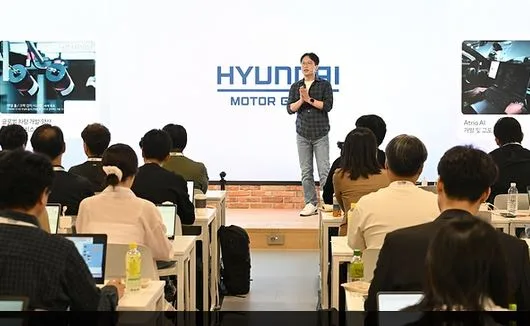
The strategy was detailed on Sept 11 at HMG Autonomous Driving Media Day, held at 42dot’s headquarters in Gyeonggi Province, South Korea.
42dot, Hyundai Motor Group’s software subsidiary, also outlined work on Atria AI and its Vision-Language-Action, or VLA, technology.
VLA is intended to help AI interpret what it sees, reason about a situation and decide what action to take.
Hyundai also released footage of an Atria AI-equipped software-defined vehicle testbed driving through complex urban traffic without driver intervention. The company described the system shown as having “Level 2++” capability.
That label is Hyundai’s own terminology rather than an official SAE automation level. Systems within the Level 2 category remain driver-assistance technology, with the driver responsible for supervising the vehicle.
Minwoo Park, president and head of Hyundai Motor Group’s Advanced Vehicle Platform division and CEO of 42dot, said autonomous-driving competition increasingly depends on how quickly companies can collect useful data, train their systems and put improvements into production.