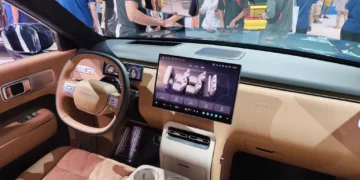




A University of Washington study published on its website says new research suggests drivers pay a measurable price when they juggle driving with tapping and swiping a car’s central touchscreen, even before extra mental distractions are added.
The University of Washington and Toyota Research Institute (TRI) study examines how people split attention between lane-keeping, touchscreen tasks and a memory test designed to mimic the mental workload of real traffic.
Using a vehicle simulator, researchers found that when participants tried to do more than one thing at once, both their driving and their touchscreen performance deteriorated.
In the simulator, the car wandered more within its lane while participants used the screen.
At the same time, drivers became slower and less accurate on the touchscreen when they were also controlling the vehicle. The decline became more pronounced once a memory task was layered on top.
The research team presented the work on Sept 30 at the ACM Symposium on User Interface Software and Technology in Busan, South Korea.
“We all know it’s dangerous to use your phone while driving,” University of Washington professor James Fogarty said. “But what about the car’s touchscreen? We wanted to understand that interaction so we can design interfaces specifically for drivers.”
The study involved 16 participants. Sensors tracked eye gaze and finger movements, along with pupil diameter and electrodermal activity, two common indicators of cognitive load.
Participants were asked to touch specific targets on a 12-inch touchscreen, mirroring typical interactions with apps and widgets. While doing so, they completed three levels of an “N-back” memory task, hearing numbers 2.5 seconds apart and repeating specific digits.
Among the reported results: lane drift increased by 42% during touchscreen interaction; touchscreen accuracy and speed dropped 58% when driving and fell a further 17% under high cognitive load; individual glances at the screen were 26.3% shorter under high load; and a “hand-before-eye” behaviour rose from 63% to 71% once memory tasks were introduced.
The team also found that simply enlarging touch targets did not improve performance.
“If people struggle with accuracy on a screen, usually you want to make bigger buttons,” University of Washington doctoral student Xiyuan Alan Shen said. “But in this case, since people move their hand to the screen before touching, the thing that takes time is the visual search.”
The researchers suggest future systems could use in-car sensing such as eye tracking or steering wheel touch sensors to estimate attention and cognitive load, then adjust the interface so key controls are easier to access.
“Touchscreens are widespread today in automobile dashboards, so it is vital to understand how interacting with touch screens affects drivers and driving,” University of Washington professor Jacob O. Wobbrock said.