




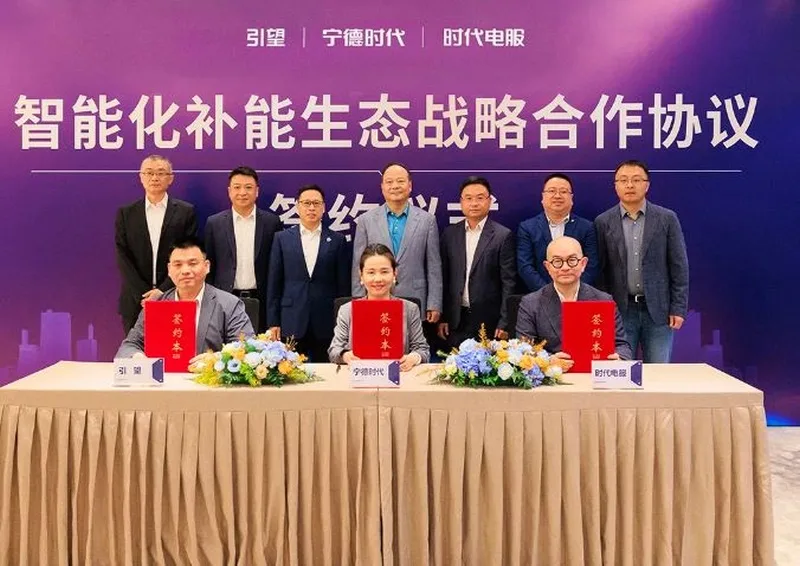
Huawei’s automotive technology company Yinwang has signed a strategic agreement with Chinese battery giant CATL to develop an intelligent battery-swapping ecosystem that could allow electric vehicles to exchange batteries without driver intervention.
The agreement, signed in Ningde, China, on Oct 19, also involves Contemporary Amperex Energy Service Technology (CAES), CATL’s battery-swapping subsidiary.
The partnership will integrate Huawei’s Qiankun intelligent driving technology with CATL’s Choco-Swap network, connecting vehicles, swapping stations and cloud-based systems.
Under the proposed system, vehicles would determine when a battery change is needed, locate a compatible station and drive into the swapping bay autonomously.
After positioning themselves, they would undergo a fully automated battery exchange taking 99 seconds before leaving the station.
The companies plan to use real-time battery information and drivers’ travel patterns to anticipate energy requirements and coordinate swapping operations.
The technology is intended for vehicles equipped with Huawei Qiankun automotive solutions, although no compatible models or commercial deployment dates were announced.
CATL has been expanding its Choco-Swap network across China. As of Sept 29, it operated 2,520 swapping stations in 200 cities, with a long-term target of 30,000 stations.
Separately, Chinese financial news outlet Cailian reported that the first vehicle under the collaboration is planned for 2027, through Dongfeng and Huawei’s Epicland brand.
However, the report did not identify the model, and the timeline has not been confirmed in the companies’ official announcement.
CATL chairman and chief executive Robin Zeng and Huawei senior vice-president and Yinwang chief executive Jin Yuzhi attended the signing ceremony.
The collaboration seeks to make battery swapping part of the intelligent driving experience, allowing vehicles to manage energy replenishment with less driver involvement.