






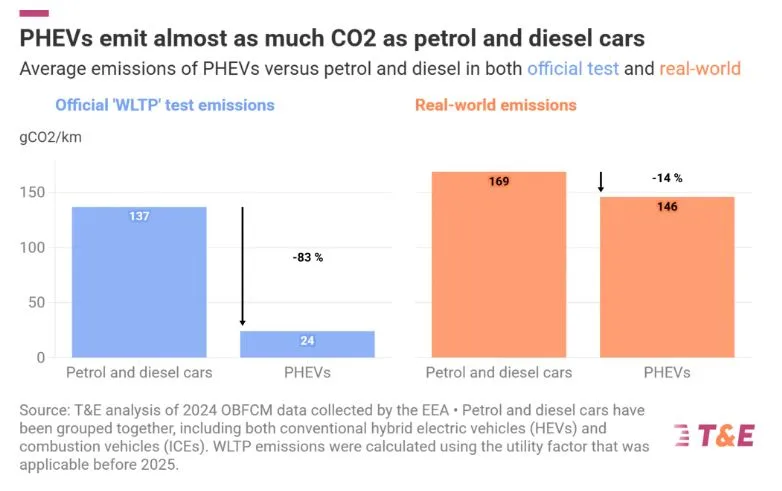
Plug-in hybrid electric vehicles (PHEVs) registered in Europe in 2024 emitted about six times more carbon dioxide (CO2) in real-world driving than their official test figures indicated, according to a new report by Brussels-based environmental group Transport & Environment (T&E).
The discrepancy widened from five times in 2023, with motorists spending an estimated €680 (RM3,130) more annually on fuel than manufacturers’ official figures would suggest.
The study, published on Oct 15 using European Environment Agency data, found that real-world PHEV emissions were only 14% lower than those of conventional combustion-engine and non-plug-in hybrid cars.
Official test figures, however, indicated an 83% reduction.
T&E also found that combustion engines operated for roughly one-third of the distance travelled even when the vehicles were running in battery-powered mode.
The European Union has begun correcting the “utility factor” used to calculate official PHEV emissions, which estimates how much driving is completed using electricity.
T&E said the first adjustment in 2025–2026 had already encouraged manufacturers to install larger batteries and extend electric driving ranges.
Volkswagen’s Tiguan PHEV was cited as an example, with its electric range increasing from 55km to 119km.
Despite the stricter calculation method, its official CO2 emissions rose only slightly, from 32g/km to 36g/km.
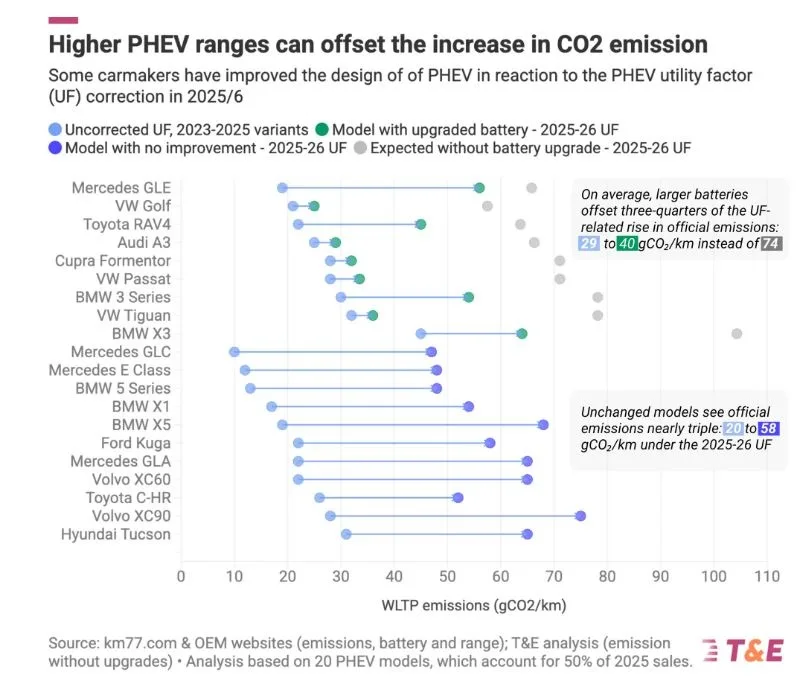
T&E said further improvements in electric range, aerodynamics, energy recovery and combustion efficiency could help manufacturers keep emissions below 50g/km under tighter rules.
However, Germany is pushing to freeze the next utility-factor adjustment, scheduled to begin in November 2026, amid wider negotiations over European automotive regulations.
T&E cars director Lucien Mathieu warned that delaying the correction would allow manufacturers to continue overstating how frequently PHEVs operate electrically.
The organisation estimated that retaining the existing rules would leave real-world PHEV emissions underestimated by 56%, while reducing the number of battery-electric vehicles manufacturers would need to sell to meet EU emissions targets for 2030.