







Let’s be honest: if you’ve been trying to follow Malaysia’s electric vehicle (EV) import policy since the start of 2026, you’ve earned a headache.
The Ministry of International Trade and Industry (Miti) has reversed, revised and reissued its own rules once too many times in the past five months that distributors — people who run actual businesses, employ actual staff, and need to order inventory months in advance — have been left guessing at what the rules even are on any given Tuesday.
That is why the May 6 announcement cannot be read in isolation. It came after months of stop-start rule changes, with distributors trying to order cars, brief dealers and plan launches while the ground kept shifting.
Here is where things actually stand.
From July 1, 2026, any fully imported or CBU EV shipped into Malaysia under the franchise AP system must have a declared CIF value — cost, insurance and freight, before a single sen of duty — of at least RM200,000.
It must also produce a minimum of 180 kW/245 PS. Neither condition existed before the end of last year in quite this form.
How Miti’s CBU EV rules changed
The original CBU EV tax exemption was announced under Budget 2022 and was meant to run until the end of 2023.
It was then extended twice: first to end-2024 during the first Budget 2023 tabling in October 2022, then to end-2025 under the re-tabled Budget 2023 in February 2023.
By late 2025, the industry appeared to have expected the tax holiday to end, but with the RM100,000 baseline floor continuing once import and excise duties returned.
Just as the exemption expired, Miti introduced new CBU EV requirements effective Jan 1, 2026. The first version set a minimum selling price of RM250,000 and minimum output of 200 kW/271 PS, but applied the conditions only to new-to-Malaysia brands yet to receive franchise APs.
Existing brands and already-approved CBU EV models could still fall back on the previous RM100,000 minimum price, although without the tax-free treatment.
Three weeks later, the wording changed. On Jan 21, PaulTan reported that Miti’s franchise AP wording had been expanded from “brand” to “brand/model”, meaning the RM250,000 and 200kW requirements now also covered new models from existing brands.
So an existing model already on sale could remain under the old RM100,000 floor, but a new model from the same brand would have to clear the RM250,000 and 200kW hurdles.
Then came Miti’s May 6 statement. From July 1, 2026, all CBU EV imports must meet two main conditions: a minimum CIF value of RM200,000 and motor output of at least 180 kW. The power threshold was lowered from 200 kW to 180 kW, but the shift from showroom price to CIF value changes the cost equation.
On the surface, RM200,000 CIF looks lower than a RM250,000 retail floor. In practice, once taxes and margins are added, it points to a much higher on-the-road price for qualifying CBU EVs.
What RM200,000 CIF actually means at the showroom
Miti has not announced an official retail price floor. Strictly speaking, the ministry has set a CIF floor instead. In practical terms, though, that still pushes qualifying CBU EVs much higher up the price ladder.
A RM200,000 CIF value refers to the cost, insurance and freight value of the vehicle before local duties, taxes, local logistics, distributor margin and dealer margin are added.
Without the old exemption, CBU EVs are again exposed to import duty, excise duty and sales tax. The standard structure is generally cited as 30% import duty, 10% excise duty and 10% sales tax, although Chinese-made EVs benefit from a lower 5% import duty under the Asean-China FTA.
Malay Mail has estimated that a RM200,000 CIF vehicle could reach around RM286,000 before distributor and dealer margins are included. That figure appeared to reflect the 30% import duty and 10% excise duty layers before further additions.
For Chinese-built EVs, PaulTan’s calculation used the more favourable 5% import duty, plus 10% excise duty and 10% sales tax, bringing the distributor’s effective cost to around RM250,000. Once distributor and dealer margins are added, the likely retail price starts at roughly RM300,000.
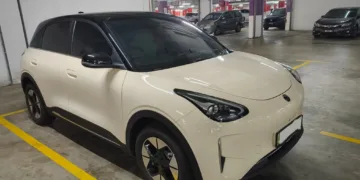
The result is the same for buyers: the RM100,000-to-RM180,000 band of imported EVs is effectively gone for new arrivals through the CBU channel. That is the space now occupied by models such as the BYD Atto 3, MG4 and Leapmotor C10.
Existing stock, port stock and in-transit units may still be cleared under the previous exemption terms, so there could be sell-down deals in the short term. Once that pipeline runs dry, however, this mainstream imported EV tier largely disappears unless brands move to CKD or local assembly.

Who really benefits
Miti’s official line is that the policy supports transparent, consistent and balanced conditions for the automotive sector while protecting national economic interests and vehicle users. That phrasing is doing a lot of work.
The practical beneficiaries are not hard to identify.
Brands with established CKD production in Malaysia — or with CKD plans far enough advanced to absorb this shift — survive the transition without a fundamental business problem.
Those going exclusively CBU face either an abrupt move upmarket or a scramble to accelerate local assembly.
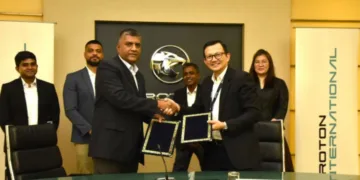
The Proton eMas 5, notably, continues to enjoy a separate CKD-bridging dispensation allowing it to sell as a CBU import from China at prices well below RM100,000. That exemption from the new CIF and power requirements while it applies to competitors is, shall we say, glaring.
Motoring site DSF raised the question that a number of industry observers have been circling: if the goal is faster electrification, how does removing the affordable imported options help?
The counter-argument — that forcing CKD investment builds long-term local industry — is legitimate in principle. The problem is the timing and the execution.
You cannot announce in December, revise in January, revise again in May, and then express surprise that brands feel unable to plan.
PaulTan’s analysis had gone further, arguing that the rules could sharply favour Proton and CKD-backed brands while leaving CBU-heavy players scrambling.
BYD, whose Tanjung Malim assembly plans are reportedly being stalled by an 80 percent export quota requirement, finds itself squeezed from two directions at once.
What this probably means for the market
Malaysia’s EV market is at real risk of splitting in a way that serves neither consumers nor the electrification agenda particularly well.
On one side: a cluster of locally assembled or CKD models below RM150,000, dominated by a small number of brands with either domestic production or special dispensations.
On the other: a thinning band of premium CBU imports above RM300,000 for buyers willing to spend at that level.
The middle — the RM150,000-to-RM280,000 range where most competitive mainstream EVs from global brands live — could become structurally empty for imported options.
That gap is where the policy’s logic is hard to defend on consumer welfare grounds.
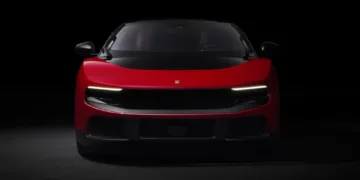
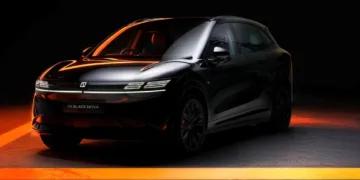
The 180 kW power minimum is not a safety threshold. It is not a quality benchmark. It is a specification filter that happens to eliminate most affordable, practical family EVs while permitting in exactly the kind of high-output luxury product that Malaysia’s upper-income buyers were going to buy regardless.
The industry will adapt. It always does.
Some brands will accelerate CKD plans. Others will quietly exit the Malaysian market or mothball launches. Buyers who were sitting on the fence will either move fast on remaining stock or accept that the window has closed.
The issue is not just the policy itself, but the way it has arrived: not as a carefully sequenced industrial transition, but through repeated rule changes, followed by a final decision that gives the market roughly seven weeks to adjust.
For a government that said it wants Malaysia to lead on EVs in the region, the approach has been — there is no other word for it — chaotic.