





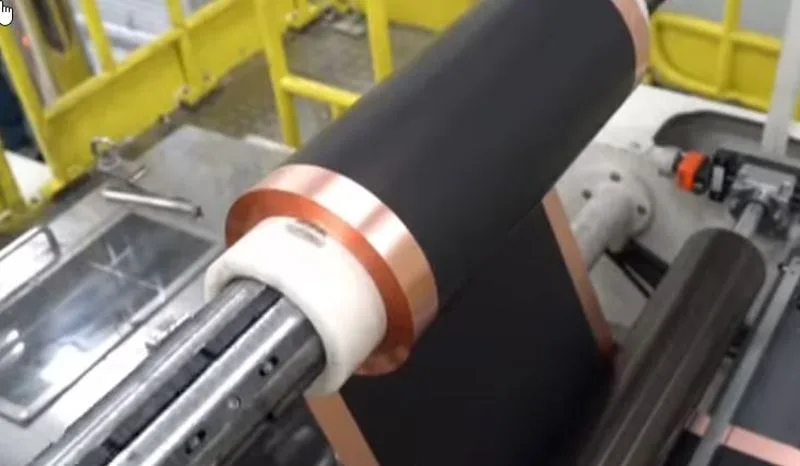
China’s solid-state battery race has moved from PowerPoint to factory floor, with Guangzhou Automobile Group Co., Ltd (GAC) confirming it has finished building the country’s first production line for large all-solid-state cells and is now running trial output.
The state-owned carmaker’s new line can turn out 60Ah-class cells, the kind of capacity normally seen in full-size EV packs rather than lab samples or gadget batteries.
For now it is only making small batches, but it is still the first time China has industrial kit dedicated to this class of solid-state cell.
Solid-state batteries ditch the flammable liquid electrolyte used in today’s lithium-ion cells and replace it with solid material. In theory, that means more energy in the same space, along with better safety and higher temperature tolerance.
GAC’s R&D chief Qi Hongzhong said the cells under development are running at almost twice the energy density of current lithium-ion units. Cars that now just clear 500km on a charge could, on this basis, push beyond 1,000km once packs based on the new chemistry are ready.
The company also quoted an areal capacity of up to 7.7mAh/cm² on the new line, compared with under 5mAh/cm² in typical “wet” lithium-ion production. In simple terms, more active material is being packed into the same footprint, and that is exactly what range-obsessed EV brands want.
Process engineering is part of the story. Instead of a conventional slurry-and-dry approach, GAC is using a dry anode method that combines mixing, coating and rolling in a single step, which it says improves efficiency and cuts energy use.
The solid electrolyte can also handle abuse temperatures of roughly 300–400°C, far above the ~200°C typical of many liquid-electrolyte cells, giving a wider safety margin in thermal events.
Nobody is pretending this is ready for mass-market crossovers next year.
GAC and Chinese state media said the current output is for validation, with small-scale vehicle installation tests pencilled in for 2026.
If those go to plan, volume production is targeted sometime in the 2027–2030 window.
Globally, every serious battery and car maker has talked up solid-state, but most efforts are still stuck at prototype level.
GAC’s line does not change the whole EV world overnight, and big questions remain around cost, materials supply and long-term durability.
What it does do is give China a visible, industrial-scale foothold in 60Ah-class all-solid-state cells.
For rivals in Japan, South Korea, Europe and the US, that is one more sign the solid-state race is no longer theoretical.