









China’s central role in Wood Mackenzie’s latest battery-electric vehicle study is no surprise.
The UK research firm has documented the country’s lead for years: in 2024 it said around 80% of battery supply chains were based in China, while a 2025 outlook put China at roughly two-thirds of global EV sales in 2024.
Its August 2026 “Electric shock” report is not a new central forecast. Instead, it models a faster-adoption scenario in which oil-market disruption, stronger policy support and quicker technology development push BEV uptake above Wood Mackenzie’s base case. PHEVs are excluded from the report’s definition of EVs.
In the base case, BEVs rise from 4% of the global passenger and commercial vehicle fleet in 2025 to 25% by 2040.
China becomes still more influential in the accelerated scenario. EV production was around 50% higher than domestic sales in 2025. Wood Mackenzie assumes tighter petrol-use rules, removal of purchase tax on EVs and larger purchase incentives, cutting estimated total ownership costs by about 30%.
Under those assumptions, annual Chinese BEV sales rise from 8.9 million in 2025 to 29.9 million in 2040, while manufacturing capacity increases 50% by 2035.

Emerging markets could see an even bigger impact. Wood Mackenzie models Chinese imports reducing EV costs there by 28%. It puts Chinese vehicles’ share at almost 30% of sales across emerging markets by 2040, roughly twice its base-case level.
Chinese investment in charging and declining fossil-fuel subsidies would also help produce an EV fleet 85% larger than in the base case.
Beyond China, Wood Mackenzie identifies oil-supply shocks, persistently high fuel prices and faster technological progress as the main accelerators.
It points to developments in rapid charging, lithium iron phosphate batteries and sodium-ion batteries, rather than treating all of them as technologies already deployed at scale.
The scenario also changes the oil outlook. Global demand falls to 99 million barrels a day in 2040, against 104 million in Wood Mackenzie’s base case. Lower transport-fuel demand could bring forward the closure of around 40 refineries.
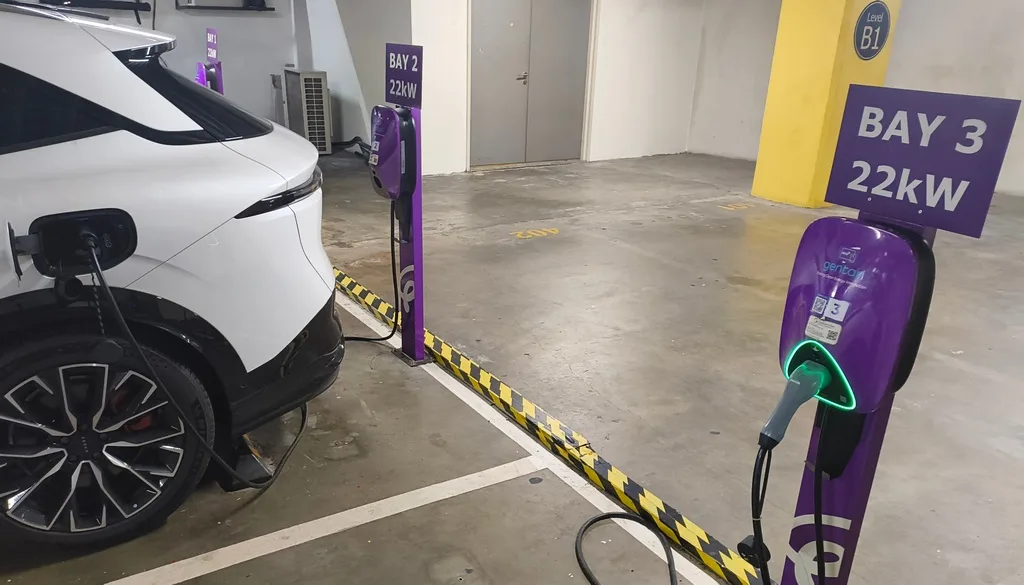
Public charging is not an immediate constraint. Around seven million public charging ports were in place worldwide at end-2025, with average utilisation of 15%.
Wood Mackenzie said that spare capacity could absorb near-term growth, but faster adoption would soon require another major infrastructure expansion. Managed charging would help shift demand away from grid peaks.