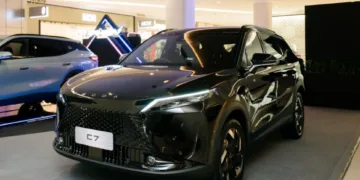





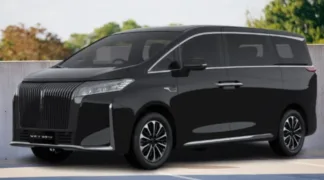




BYD is aiming to sell 1.3 million vehicles overseas in 2026, as it prepares to take its ultra-fast charging network beyond China and broaden the market for its Denza premium brand.
The target was disclosed by BYD Group branding and public relations general manager Li Yunfei during a media briefing held alongside the launch of the company’s second-generation Blade Battery and flash-charging technology.
ITHome reported that Denza would step up its overseas expansion this year, while BYD’s flash-charging stations are scheduled to go abroad by the end of 2026.
In Malaysia, Denza is already present through the D9 electric MPV, launched in February last year. The Z9 GT appears to be next in line for this market, while other models such as the N9, N7 and B5 have been discussed without firm local confirmation so far.
That gives the latest BYD expansion story two fronts. One is sales. The other is infrastructure.

CarNewsChina added that BYD is expected to prioritise export markets where it already has active local manufacturing, and pointed specifically to Europe and Asean, with production footprints in Thailand, Brazil and Hungary.
That suggests BYD is not just shipping cars out of China, but trying to build a fuller ecosystem in markets where it already has some industrial base.
ITHome said BYD sold about 4.6 million new energy vehicles in 2025, including around 2.26 million battery-electric vehicles. It also reported that overseas deliveries, including passenger vehicles and pick-ups, exceeded 1.04 million units last year. Its 2026 overseas sales target is 24% up over last year’s.
The company is also trying to make a statement with charging hardware. BYD formally introduced what it called the world’s highest-power mass-produced single-gun charging pile, with output of up to 1,500kW.
ITHome reported the headline number, while CarNewsChina added that the system runs on a 1,000V architecture and uses an integrated “storage + charging” setup with 200–300kWh of energy storage per pile to reduce grid strain.

CarNewsChina also said compatible vehicles such as the Denza Z9 GT and Yangwang U7 can charge from 10% to 70% in about five minutes, and that BYD claims strong cold-weather performance, including a 20% to 97% charge in 12 minutes after 24 hours at -30°C.
Those are eye-catching figures, though they remain manufacturer claims and will depend on the vehicle, battery condition and site capability in the real world.
At home, BYD said it plans to build 20,000 flash-charging stations across China by the end of 2026, including 18,000 urban sites and 2,000 highway locations.
The first 1,000 highway stations are due online before May 1, 2026. As of today, the company said it had already built 4,239 stations.