
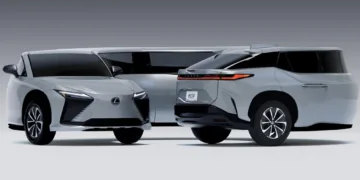







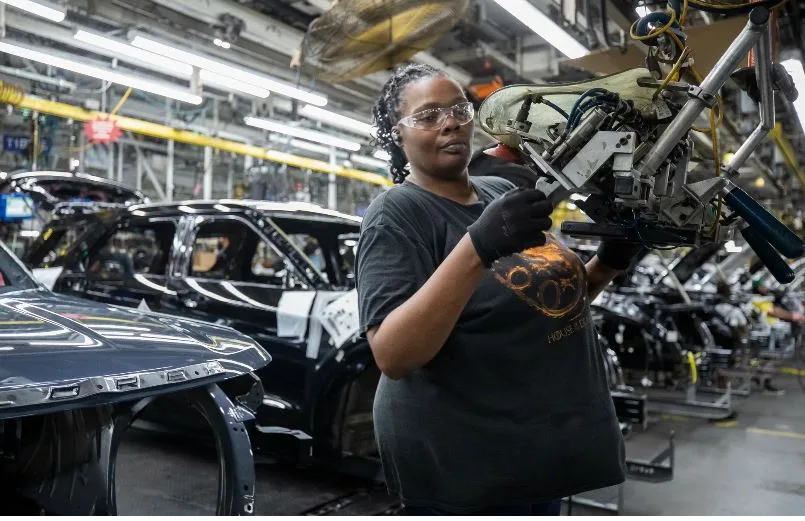
Ford is dialling back investment in some battery-electric vehicles as it turns towards battery energy storage, hybrids and good old internal-combustion cars and trucks, arguing that the numbers no longer stack up for certain larger EVs.
The company said demand has not met earlier expectations, costs stayed stubbornly high and the regulatory outlook had shifted.
So, rather than chase volume at any price, Ford said it is redeploying capital to areas with clearer, faster returns, including its trucks and vans business, plus a new battery energy storage systems (BESS) unit aimed at data centres and grid infrastructure.
“This is a customer-driven shift to create a stronger, more resilient and more profitable Ford,” Ford president and CEO Jim Farley said.
Even with the reset, Ford does not walk away from electrification. By 2030, it expects hybrids, extended-range EVs and full EVs to account for about 50% of its global volume, up from 17% in 2025.
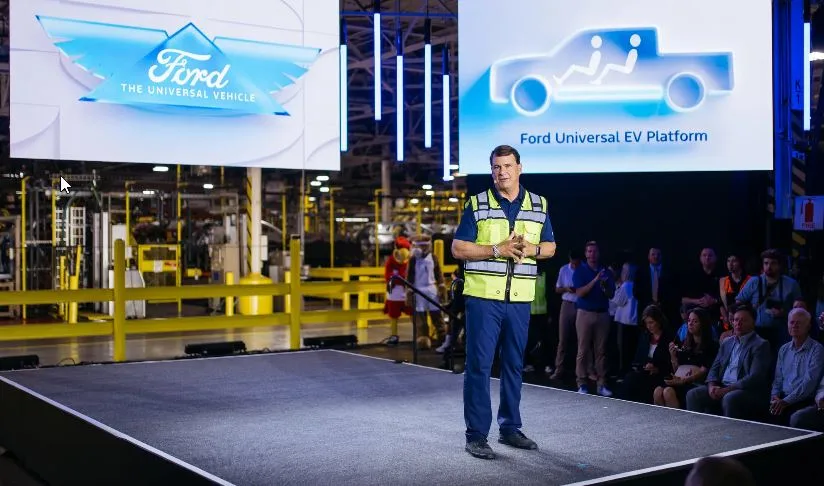
The mix is a calculated bet. Ford is effectively saying full battery-electric is no longer the default answer for every buyer, every job, every region.
On the EV side, Ford now concentrates North American development around a low-cost “Universal EV Platform” for smaller, more affordable models.
The first vehicle on that architecture is a connected midsize pickup scheduled to be built at Louisville Assembly Plant from 2027.
For its bigger nameplates, Ford would use extended-range tech. It said the next-generation F-150 Lightning would move to an extended-range electric vehicle (EREV) set-up, with an estimated 1,127km of range, while keeping electric drive.
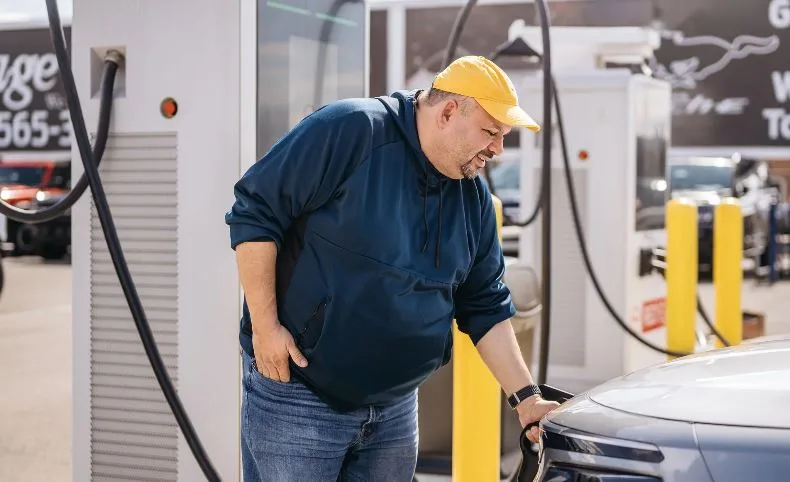
Put simply, this is Ford chasing the convenience and towing confidence that many truck buyers still want, without asking them to live around a public charger.
Manufacturing plans shift with it.
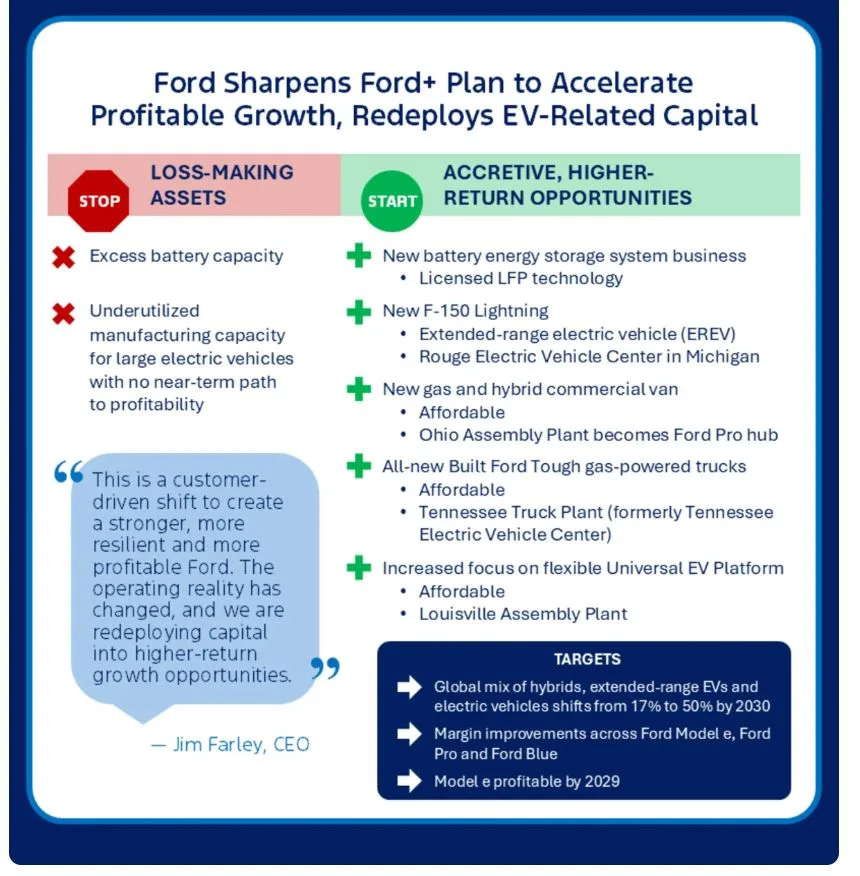
At BlueOval City in Tennessee, what was pitched as an EV centre is now renamed Tennessee Truck Plant, with new petrol-powered pickups planned from 2029. Ohio Assembly Plant is set to produce a new gas and hybrid commercial van from 2029.
The other big move is energy storage. Ford said it plans to start shipping BESS products in 2027, targeting 20GWh of annual capacity by late 2027, using LFP technology and leveraging existing plants in Kentucky and Michigan.
It also plans about US$2 billion of investment over the next two years to scale that business.
All of this comes with a price tag.
Ford expects around US$19.5 billion in special items, mostly in the fourth quarter of 2025, plus roughly US$5.5 billion in cash effects mainly in 2026 and 2027. It also lifts its 2025 adjusted EBIT guidance to about US$7 billion.