



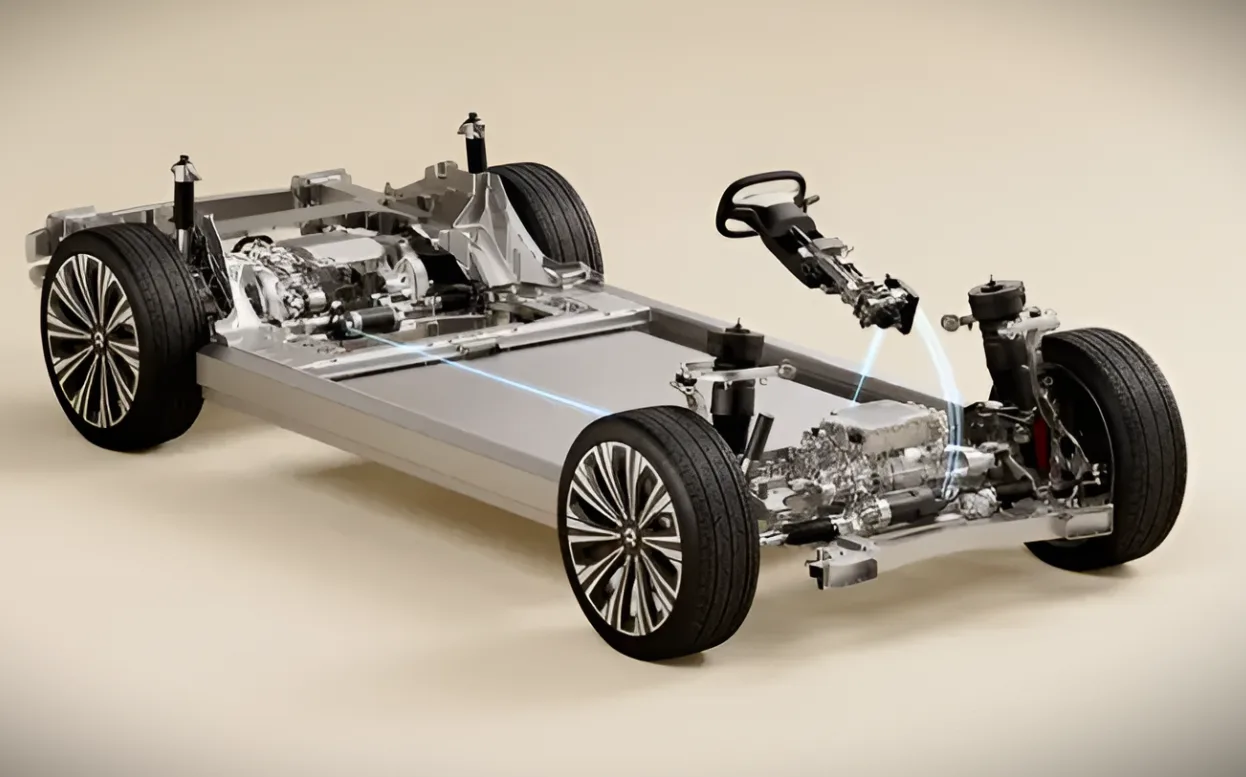
China has signed off a new national steering standard that, for the first time, allows cars to steer with no physical shaft between the steering wheel and the front axle.
In effect, full steer-by-wire will be legal from mid-2026, as long as carmakers hit tougher safety rules.
According to Chinese tech outlet IT-home, the regulation is called GB17675-2025 “Steering system of motor vehicles – Basic requirements” and was recently published on the Ministry of Industry and Information Technology website. It will replace the current GB17675-2021 standard from July 1, 2026.
The big change is straightforward but hugely consequential. To make room for steer-by-wire (SBW) and modern electric power steering (EPS), the new rulebook drops the long-standing requirement for a mechanical link between wheel and wheels.
Future systems can send steering commands entirely via electronics, with no metal column as backup, provided they meet strict redundancy and safety criteria.
IT-home reported that the update was drafted by a wide alliance of industry players.
On the Chinese side are Nio, Li Auto, Xpeng, BYD, Geely, Xiaomi Auto and Huawei Digital Energy. They are joined by joint-venture and foreign-backed outfits, including Toyota’s China EV R&D hub and Mercedes-Benz (China) Investment.
China is not starting from zero. Cars such as the Infiniti Q50, IM L6, Nio ET9 and Tesla Cybertruck already use some form of steer-by-wire.
The Q50 keeps a mechanical fallback, while the ET9 (pic) is promoted as the first fully steer-by-wire model in China to reach series production and customer delivery.
To avoid trading metal for risk, the new standard draws on the latest UN R79 update and ISO 26262.
It lays down detailed rules for backup operation if the steering system fails, clear “degraded mode” behaviour, fault warnings and additional test procedures for full electric steering, including how the energy storage and management systems must behave when things go wrong.