









When the Neta V was launched last year, it was the cheapest electric vehicle in Malaysia. It still is at RM100,000 (or thereabouts) although it went even cheaper at under RM80,000 in its early days when rebates and promotions were thrown in.
It’s now known for another record. And not a good one at that.
The New Car Assessment Program for Southeast Asian Countries (Asean NCAP) has just declared the Neta V as its most unsafe car in the 2021–2025 protocol, giving it a zero-star rating.
This is highly unusual, which is why the electric hatchback deserves to be tagged in tiencars as “Offbeat”.
However, it’s not the first-ever car under Asean NCAP to get such abysmal rating. Since Asean NCAP was set up in Malaysia in 2011, a number of other cars have earned such poor ratings, which included the Renault Kwid (tested in 2016), Hyundai EON (2016) and Kia Picanto (2014).
Testing protocols for car safety assessments like those of Asean NCAP, Euro NCAP, and Australia’s ANCAP evolve over time to address advancements in technology, emerging safety challenges, and changing consumer expectations.
Now that we have the contextual details in place, let’s zero back into the Neta V.
Just think. If Asean NCAP gives the Neta V such poor ratings, imagine what Euro NCAP and ANCAP will have to say about it. Both the European and Australian testing protocols set a higher safety bar than Asean NCAP, which is designed to suit developing markets in Southeast Asia, where many vehicles are more affordable and may not have advanced safety features.
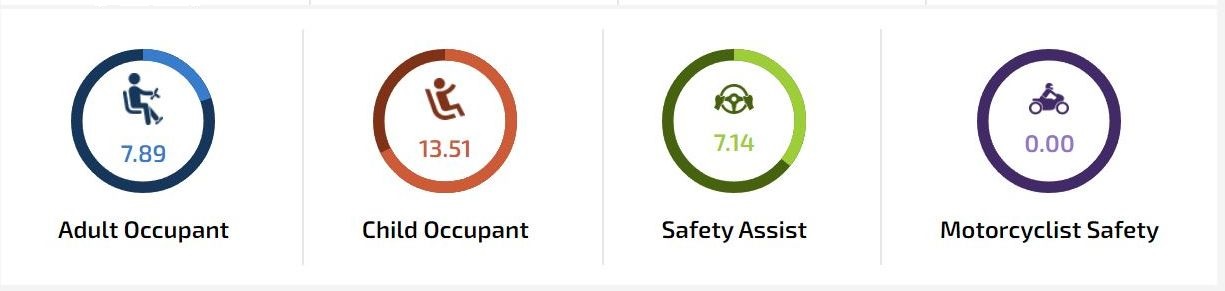
The Asean NCAP test evaluated the Neta V across four categories: Adult Occupant Protection (AOP), Child Occupant Protection (COP), Safety Assist (SA), and Motorcyclist Safety (MS).
The vehicle scored 28.55 points overall, with breakdowns as follows: AOP (7.89 points), COP (13.51 points), SA (7.14 points), and MS (0.00 points).
In the AOP category, the Neta V performed poorly in both frontal offset and side impact tests. The frontal offset test revealed significant weaknesses, including a lack of protection for the driver’s head, neck, chest, and right lower leg.
The car scored zero points in this test, highlighting issues such as weak body structure and the absence of critical restraint technologies, including seatbelt pre-tensioners and load limiters.
These deficiencies led to higher injury risks, with steering wheel displacement and A-pillar integrity also noted as concerns. In the side impact test, the Neta V earned 6.31 points out of 8.00, with marginal chest protection recorded.
The COP assessment showed mixed results. While the Neta V performed adequately in frontal offset and side impact tests, it scored poorly in Child Restraint System (CRS) installation and vehicle-based assessments.
Despite having ISOFIX and top tether fittings, the vehicle was incompatible with more than half of the recommended CRS options.
The SA category reflected the vehicle’s lack of advanced safety features. The Neta V does not include Autonomous Emergency Braking (AEB), Forward Collision Warning (FCW), Lane Keep Assist (LKA), or Lane Departure Warning (LDW). Similarly, it lacks technologies critical for motorcyclist safety, such as Blind Spot Technology (BST), Auto High Beam (AHB), and Pedestrian Protection (PP), leading to a zero score in the MS category.
The Neta V’s poor performance has drawn attention to the importance of basic and advanced safety features in electric vehicles.
Safety experts emphasised the critical role of equipment like seatbelt pre-tensioners and load limiters, which could significantly enhance occupant protection.
The 2021–2025 Asean NCAP protocol allocates 40 points to AOP, with the remaining 60 points divided equally among COP, SA, and MS. The Neta V’s results demonstrate a failure to meet fundamental safety benchmarks.
The Asean NCAP and the Malaysian Institute of Road Safety Research (Miros) urged EV manufacturers to prioritise safety features as consumer demand for electric vehicles grows in Southeast Asia.
The Neta V, sold alongside the Neta X SUV, are distributed in Malaysia by Intro Synergy.
The Neta V, offered in a single variant locally, is equipped with a 70kW/94hp electric motor and a ternary lithium battery with a capacity of 38.54 kWh for a range of 380km (NEDC) or 300km (WLTP, the more realistic measure).