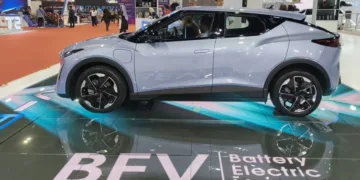
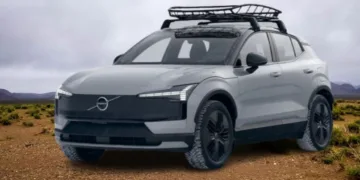










Polestar has announced that its upcoming Polestar 7, a premium compact SUV to be built in Europe, will take centre stage in the company’s shift to a more active sales model.
This new approach involves working with additional retail partners and expanding physical locations.
Polestar, a Volvo spinoff, plans to grow from 70 to 130 and from 36 to 57 retail spaces across Europe and North America by 2026, enhancing its already direct-to-consumer online channel.
Sales in France will begin this year, marking another key milestone in the company’s strategy.
Alongside Polestar 7, the brand is updating its line-up to include Polestar 5, expected to launch later in 2025. These additions build on Polestar’s existing range of electric vehicles, including Polestar 2, Polestar 3, and Polestar 4.
The aim is to achieve annual retail sales growth of 30-35% between 2025 and 2027, with adjusted EBITDA turning positive in 2025. Polestar also foresees generating positive free cash flow after investments by 2027, as it continues to refine margins, reduce fixed costs and improve working capital.
By moving to a single architecture from Polestar 7 onwards, the company intends to cut complexity and costs across its portfolio. The manufacturing footprint will remain global, with plants in the USA, South Korea, China, and now Europe.
Polestar CEO Michael Lohscheller believes these initiatives will make 2025 the strongest year in the company’s history. Geely, a major stakeholder, will keep supporting Polestar’s growth by helping secure further equity and debt financing.
Polestar is also boosting revenue by selling CO2 credits, anticipating demand to rise as traditional carmakers grapple with electrification targets.
From 2025, the brand expects this initiative to generate a three-digit million-dollar contribution each year, having already formed a European CO2 pooling agreement with four other manufacturers.
In addition, Polestar is rolling out its new Polestar Energy offering, intended to reduce home charging costs by up to 30%. Customers can manage their charging through an app, with further benefits for supplying power back to the grid.
More markets will gain access to this service in the second half of the year, coinciding with the introduction of bidirectional charging in Polestar’s range.
Finally, Polestar Charge promises improved convenience for long-distance drivers. European owners can access over 850,000 charging points, including Tesla Superchargers, while North American customers gain use of more than 17,800 Tesla Superchargers via an adaptor.