





Toyota has pulled the covers off what is arguably its most advanced car yet.
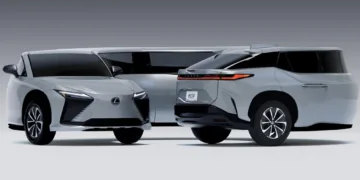
The bZ7 electric flagship made its public debut at Auto Guangzhou 2025, giving the brand’s China range a high-tech halo model shaped by local engineering and powered by Chinese software and hardware partners.
At the heart of the bZ7 story are three key technologies that do not usually appear together in this price bracket: dual-chamber air suspension, a HarmonyOS-based digital cockpit and LiDAR-supported advanced intelligent driving.
With this car, Toyota’s joint-venture effort steps into a space that, until very recently, was dominated by China’s own premium EV players.
Developed under the GAC Toyota joint venture, the bZ7 is now open for pre-orders in the 200,000-yuan (RM117,000) segment.
Toyota is positioning it as a “top choice” among luxury pure-electric sedans at under US$30,000 (RM125,000), a pitch clearly aimed at value-conscious buyers who still want the full tech suite rather than a stripped-down entry EV.

The car itself is a sizeable four-door. It measures 5,130mm long, 1,965mm wide and 1,500mm tall, with a 3,020mm wheelbase.
On paper, that puts it broadly in the same footprint as a Tesla Model S or BYD Han, which gives an idea of how much metal and cabin space is on offer.
Underneath, Toyota relies heavily on Huawei.
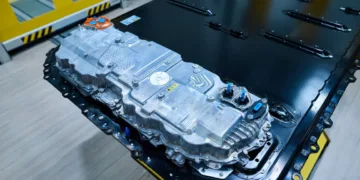
A Huawei-supplied motor delivers up to 207kW, with a claimed top speed of 180kph, while lithium iron phosphate batteries from CALB feed the drivetrain.
Two battery options are planned: 88.13kWh with a quoted 680–710km CLTC range, and 71.35kWh with a 600km figure. Those are test-cycle numbers rather than real-world claims, but they still give the bZ7 a competitive range on paper.

The cabin is where the collaboration is most visible.
The HarmonyOS / HarmonySpace cockpit acts as the car’s operating system, tying together infotainment, navigation, climate and driving functions through a large central screen and a fully digital interface. It feels more like a smart device that happens to have wheels.
There is more. The bZ7 also plugs into Xiaomi’s “Human x Car x Home” ecosystem, so owners can check and control compatible smart-home devices from the driver’s seat or via a connected phone.
Lights, air-conditioning and appliances can be managed on the go, which is the sort of integration Chinese buyers are used to from domestic EV brands.


On the driver-assistance side, a roof-mounted LiDAR unit and software from local supplier Momenta provide the backbone of the latest ADAS package.
The system supports Navigation on Autopilot in both city and highway settings, taking over more of the driving load on mapped routes while still keeping the driver in the loop.
Toyota said this makes the bZ7 more intelligent than any of its current global models, a sign of how far its China-focused R&D has evolved in just a few years rather than a casual boast.
Ride comfort is handled by the dual-chamber air suspension, paired with premium chassis tuning.
The set-up aims to give the big sedan a cushioned, almost limousine-style ride, while still tightening body control when the pace rises. It is tailored to Chinese customers who want EV performance but are not willing to sacrifice comfort to get it.

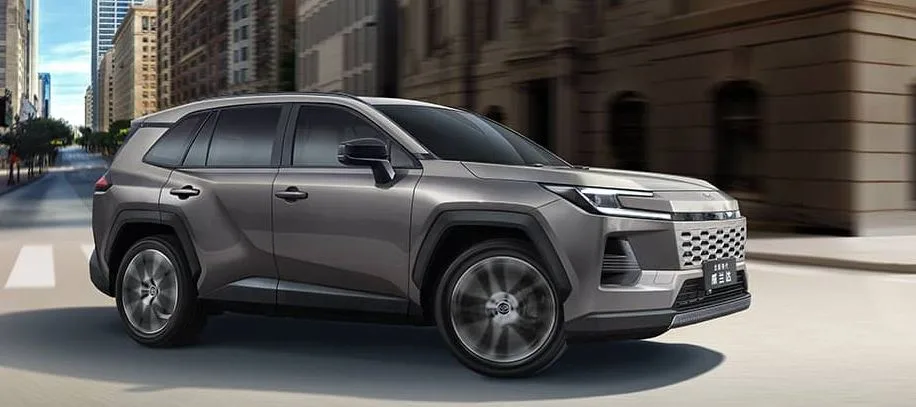
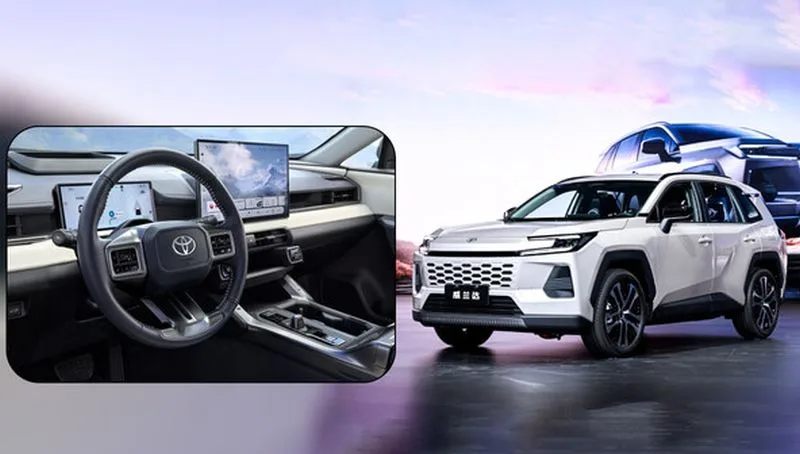
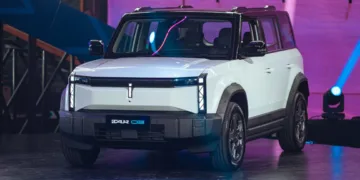
Launched alongside the bZ7 is the all-new Wildlander, the Chinese twin of the RAV4.
It follows Toyota’s latest SUV design language with C-shaped headlamps and a full-width LED daytime running strip. Dimensions come in at 4,600mm long, 1,855mm wide and 1,680mm tall, with a 2,690mm wheelbase, keeping it in the family SUV bracket.
Built on the TNGA-K platform and using Toyota’s fifth-generation THS hybrid system, the Wildlander will be available with a 2.0-litre petrol engine and hybrid variants.
It is aimed at buyers who still prefer combustion power but now expect the same connected, intelligent experience they see in EVs.
Inside is where that shift is most obvious.

The Wildlander becomes the first Toyota petrol model in China to adopt a fully China-developed intelligent cockpit running on a domain-control electronic architecture.
A 15.6-inch ultra-narrow-bezel centre screen, the largest Toyota has fitted in this class, anchors the cabin. Large-language-model voice control, more than 10 gesture operations and a reworked driver-assistance suite round out the tech offering.
GAC Toyota claims this finally gives sub-200,000-yuan gasoline buyers an in-car experience that feels closer to a pure EV than a traditional SUV.

Both models were unveiled within 24 hours, a timing the joint venture is using to underline its dual-track strategy: push deeper into pure-electric flagships while modernising its core petrol and hybrid SUVs.
With sales nearing 640,000 units between January and October and annual output projected at about 770,000 vehicles, GAC Toyota is betting that heavier localisation and broader electrification will keep it relevant in China’s fast-shifting market.