









Thailand’s National Electric Vehicle Policy Committee (EV Board) approved today an amendment to its EV3 and EV3.5 incentive schemes that will count each battery-electric vehicle (BEV) produced for export as 1.5 units towards manufacturers’ local production targets.
The change, proposed by the Federation of Thai Industries (FTI), aims to position Thailand as a regional BEV export hub and is projected to boost electric vehicle exports to about 12,500 units in 2025 and 52,000 units in 2026.
Under the original EV3 framework, manufacturers were required to “compensate” for imported BEVs by matching them with locally produced units before qualifying for further subsidies.
The revised rule reduces this burden by applying the 1.5× multiplier for each exported vehicle.
In tandem, the Board extended by one month the deadline for domestic-market registrations under both schemes, allowing cars sold by 31 Dec 31, 2025 to be registered until Jan 31, 2026 (EV3) and those sold by Dec 31, 2027 to be registered until Jan 31, 2028 (EV3.5).
“Today’s amendments will grant greater flexibility and encourage manufacturers to export more,” said Narit Therdsteerasukdi, Secretary General of the Thailand Board of Investment (BOI) and secretary of the EV Board, at a press briefing in Bangkok.
“Thailand is already the region’s automotive leader; these measures will cement its role as a key EV production base.”
The board also reviewed progress across the sector, noting cumulative approved investment in the local EV supply chain has reached 137.7 billion baht (around US$4.2 billion) as of June 30.
Of this, 41.08 billion baht is earmarked for eight passenger car projects with a combined annual capacity of 386,000 units; 80.1 billion baht for 53 battery cell and module plants; 6.52 billion baht for 42 component makers (traction motors, battery management systems, DC-DC converters and on-board chargers); and 5.56 billion baht for 29 charging-station ventures targeting 20,080 outlets (including 7,360 DC fast chargers).
Smaller allocations include 990 million baht for 16 electric-motorcycle projects, 2.21 billion baht for three bus and truck schemes, and 1.28 billion baht for battery-swap facilities.
On the consumer front, Thailand has disbursed more than 12 billion baht in subsidies to date, supporting 175,064 BEVs and 34,559 electric motorcycles under EV3.0 and EV3.5.
In the first half of 2025, registrations of new BEV cars rose by 52.4 per cent year-on-year to 57,289 units, representing 15 per cent of all new passenger vehicles.
Total BEVs on the road now stand at 203,000, alongside 71,900 electric motorcycles, 3,800 electric buses and trucks, and 1,000 electric tuk-tuks.
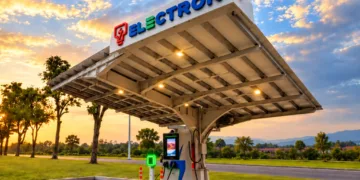
Infrastructure has also outpaced initial forecasts. As of March 2025, there were 3,720 operational charging stations nationwide, comprising 11,622 chargers, of which 6,524 are DC fast-chargers—a figure 48 per cent above the year-end target of 4,400.
The government’s “30@30” policy aims for 30 per cent of all vehicles produced locally to be electric by 2030, and the plan anticipates 12,000 DC fast-chargers by that year.
Participation in the incentive schemes remains robust: 27 firms are enrolled in EV3 (16 passenger-car and pickup makers, and 11 motorcycle producers), while 10 passenger-car manufacturers have joined EV3.5.
Revised subsidy-disbursement criteria were also adopted to strengthen fiscal prudence.
Under the new rules, EV3 companies opting not to extend their compensatory production period must submit monthly forecasts and will have subsidies withheld until they achieve at least half of their required output.
Those requesting an extension or joining EV3.5 must furnish bank guarantees of 20 million baht (for registered capital of 5 billion baht or more) or 40 million baht (for smaller firms).
All participants may revise their import-compensation plans, and firms that choose to forfeit subsidies on previously imported and registered vehicles can repay the excise-tax differential plus penalties to eliminate compensatory production obligations.