






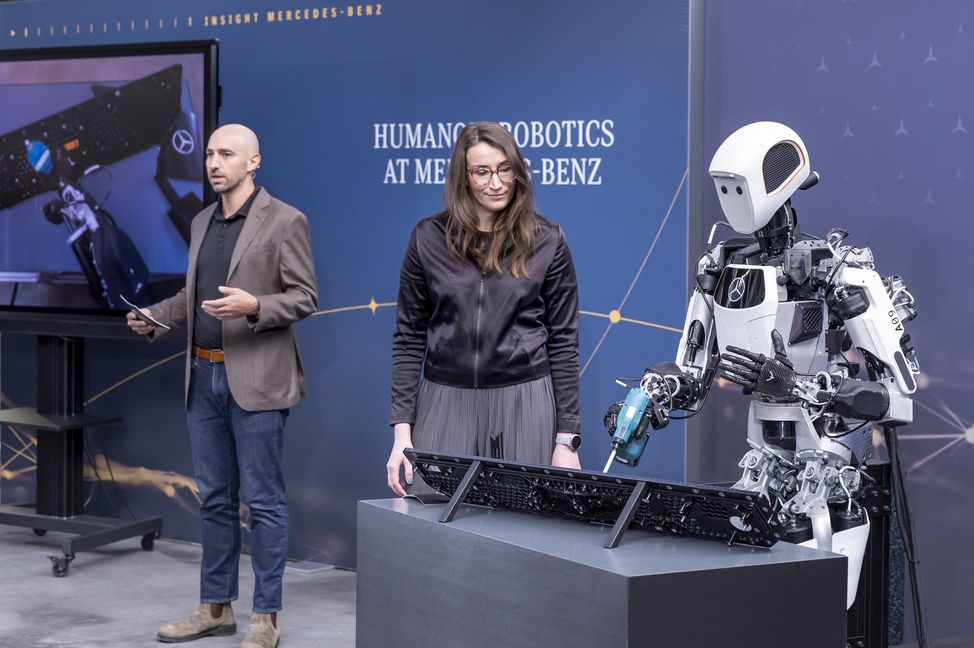
Mercedes-Benz is spearheading a robotics revolution within its manufacturing network, focusing on the integration of humanoid robots to tackle repetitive and hazardous tasks.
The company has bought a stake in Apptronik, a Texas-based firm established in 2016 that is competing with Tesla and Nvidia-backed Figure AI. Reuters reported the investment as being in the “low double-digit million-euro sum.”
Apptronik’s Apollo robots are currently being trialled to transport components to production lines and execute preliminary quality inspections. These robots are initially trained through teleoperation and augmented reality, with the aim of eventually operating autonomously.
Testing of the Apollo units is not restricted to Berlin. Trials are also underway at Mercedes-Benz’s facility in Kecskemet, Hungary, and further deployments are planned across other production sites.

In December, Apptronik entered a strategic partnership with Google DeepMind’s robotics team to merge advanced AI capabilities with their hardware, a collaboration expected to enhance the robots’ operational efficiency in dynamic manufacturing settings.
At the same time, Mercedes-Benz is advancing its overall digital production strategy from its Berlin-Marienfelde hub, which has been a global centre for production digitalisation since 2022 through the Mercedes-Benz Digital Factory Campus (MBDFC).
Central to these efforts is the MO360 digital production ecosystem, which consolidates critical software applications and production data across the global network.
Enhancements to the MO360 system now include AI features such as the Digital Factory Chatbot Ecosystem and the MO360LLM Suite. These tools enable staff to access vital production data and maintenance advice in multiple languages, streamlining operations and supporting swift implementation of innovative processes.

The Digital Factory Campus has also been a proving ground for the Mercedes-Benz Operating System (MB.OS), which recently played a crucial role in the launch of the new Mercedes-Benz CLA at the Rastatt plant.
Beyond digitalisation and robotics, the Berlin-Marienfelde site is set to become a centre of excellence in powertrain production.
From next year, it would start the manufacturing of high-performance electric axial-flux motors – a complex process involving nearly 100 production steps and bolstered by more than 30 new patent filings.