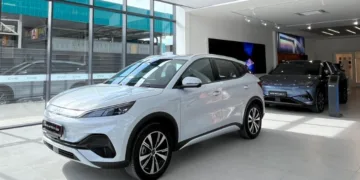




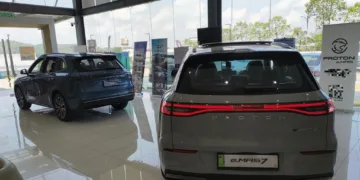




BMW has detailed the first production model of its Neue Klasse era, the fully electric iX3, ahead of series build in Debrecen, Hungary from autumn 2025.
The launch variant, iX3 50 xDrive, delivers 345kW/462hp and all-wheel drive, with WLTP energy use of 17.9–15.1kWh/100km and a provisional 679–805km range.
The model goes on sale in Europe in spring 2026, the US in summer 2026, with a China-tailored version to be assembled in Shenyang from the same period.
The model debuts sixth-generation eDrive: an 800V system with new cylindrical-cell batteries, a structural pack and mixed-motor layout—an efficient electrically excited synchronous motor at the rear and a compact asynchronous unit in front.
BMW claims 40% lower energy losses, 10% less weight and 20% lower manufacturing costs versus Gen5. Usable battery capacity is 108.7kWh.
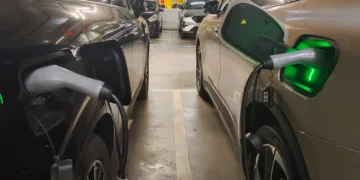
Peak DC charge power is 400kW, adding up to 372km in 10 minutes and 10–80% in 21 minutes; AC charging is 11kW standard or 22kW optional. The car supports 400V DC sites via an in-house switching matrix.

Bidirectional functions include Vehicle-to-Load, Vehicle-to-Home and Vehicle-to-Grid, enabled by accessories such as a Multifunction Charger and a BMW Wallbox Professional (DC).
An AI-driven charging flap opens automatically, while the My BMW app shows live charge speed and curve and manages multi-contract Plug & Charge.
A new design language debuts with the iX3: reduced, characterful surfaces, vertical kidneys referencing classic Neue Klasse, a fresh light signature and flush glazing/handles. Aerodynamics are tuned to a 0.24 Cd.
Dimensions are 4,782/1,895/1,635mm (L/W/H). Practicality rises with a 520–1,750-litre boot, a 58-litre front compartment and a 2,000kg braked towing limit (50 xDrive).
Inside, the cabin is pared back and spacious, with a “floating” fabric-surfaced dash, wrap-around door trims, expansive glazing and an optional panoramic roof with climate-comfort glazing.

BMW Panoramic iDrive anchors the interface on the new Operating System X. Core elements include Panoramic Vision projecting across the windscreen, an optional 3D head-up display with integrated navigation/automated-driving overlays, and a free-cut central display using matrix backlight tech with QuickSelect widgets.
Physical keys remain for essentials (wipers, indicators, mirrors, volume, gear selector, hazards, demist), while voice and touch handle the rest.
The Intelligent Personal Assistant gains two new voices, richer visuals and proactive routines, with large-language-model capabilities to follow. HypersonX driving sounds and coordinated light/sound “My Modes” personalise the ambience.
Trim options span Essential (Econeer textile), Contemporary and M Sport to BMW Individual Merino/M PerformTex.

Under the skin, a new electronics architecture uses four high-performance “superbrains” for driving dynamics, automated driving/parking, infotainment, and comfort.
The Heart of Joy controller manages powertrain, braking, recuperation and steering with up to 10× the processing speed of prior systems. BMW says 98% of routine deceleration is handled by energy recuperation, while a “Soft Stop” algorithm smooths final braking.
The motorway assistant permits prolonged hands-off driving; a City Assistant adds traffic-light detection.
Cruise control remains engaged after light braking, and lane guidance persists after small steering inputs.
Weight falls via a zoned wiring harness (–30%, –600m of cabling) and smart eFuses that enable intelligent power modes.

Standard equipment on the 50 xDrive includes heated, electrically adjustable front seats, two-zone climate control, Comfort Access, powered tailgate, extended mirrors and wireless phone charging.
Options range from three-zone climate and adaptive light functions to Iconic Glow grille illumination, a Harman Kardon 13-speaker system, heated steering wheel and 20–22-inch Air Performance wheels; M Sport and M Sport Pro packs add visual and chassis enhancements.
Sustainability targets are central. BMW says the iX3 50 xDrive’s cradle-to-grave carbon footprint over 200,000km is 34% lower than its predecessor, breaking even against an equivalent ICE model after roughly 21,500km on Europe’s grid mix or 17,500km on renewables.

About one-third of the car uses secondary materials: marine-plastic content (30%) for under-bonnet storage and covers; 100% recycled PET for Econeer seat fabric, headliner textile and carpets; 80% secondary aluminium for swivel bearings and hub carriers; and wheel castings with 70% secondary aluminium.
Debrecen’s routine operations run without fossil fuels, and BMW cites a 35% cut in supply-chain CO2e for the iX3 50 xDrive.
BMW said the iX3 is leading a tech roll-out that would affect 40 new models and updates by 2027, framing the Neue Klasse as a step-change in efficiency, software and design across its line-up.