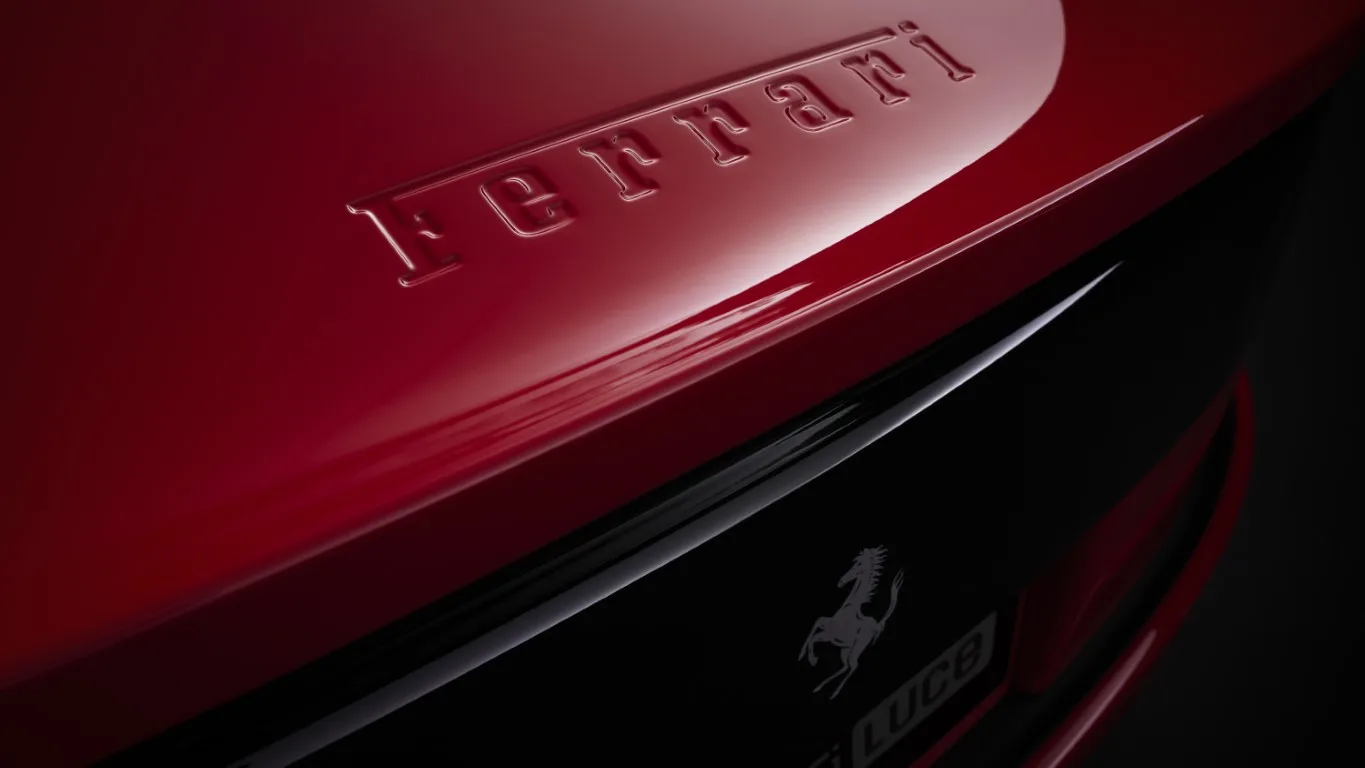






Ferrari has unveiled the Luce in Rome, giving Maranello its first fully electric production car and a very different kind of flagship.
The reveal took place at the Vela di Calatrava – Città dello Sport, a venue picked with Ferrari history in mind. Rome was where Ferrari scored its first victory in 1947, when Franco Cortese drove the 125 S to win the Gran Premio di Roma at the Baths of Caracalla circuit. The Luce arrived 79 years later, carrying a rather heavier job: proving that an electric Ferrari can still feel like a Ferrari.
The Luce is expected to go on sale in Europe later this year, with pricing understood to start at around €550,000 (RM2.5 million). That places it firmly in Ferrari’s upper tier, although Maranello is pitching it as a new kind of grand tourer rather than a direct replacement for any existing combustion model.
Early reaction has been split, as expected for a Ferrari that changes so many old rules at once. The exterior is not conventionally aggressive. It is smooth, almost calm by Ferrari standards, which may be part of the reason early reaction has been so divided.
The Financial Times described the Luce’s design as “polarising” and tied it to Ferrari’s attempt to reach younger, more tech-minded buyers, while Reuters noted that the car arrives as demand for ultra-luxury EVs has become harder to read. InsideEVs saw the cabin as the kind of departure likely to unsettle traditional Ferrari fans, but evo was more generous, suggesting the backlash may show Ferrari has at least avoided a safe, forgettable design.

Ferrari did not present the Luce as the start of an EV-only future. The car sits within the multi-energy strategy announced at the brand’s 2022 Capital Markets Day, with petrol engines, hybrids and EVs continuing side by side. In other words, the Luce is not meant to replace everything Maranello already does. It adds another way for Ferrari to build performance cars.
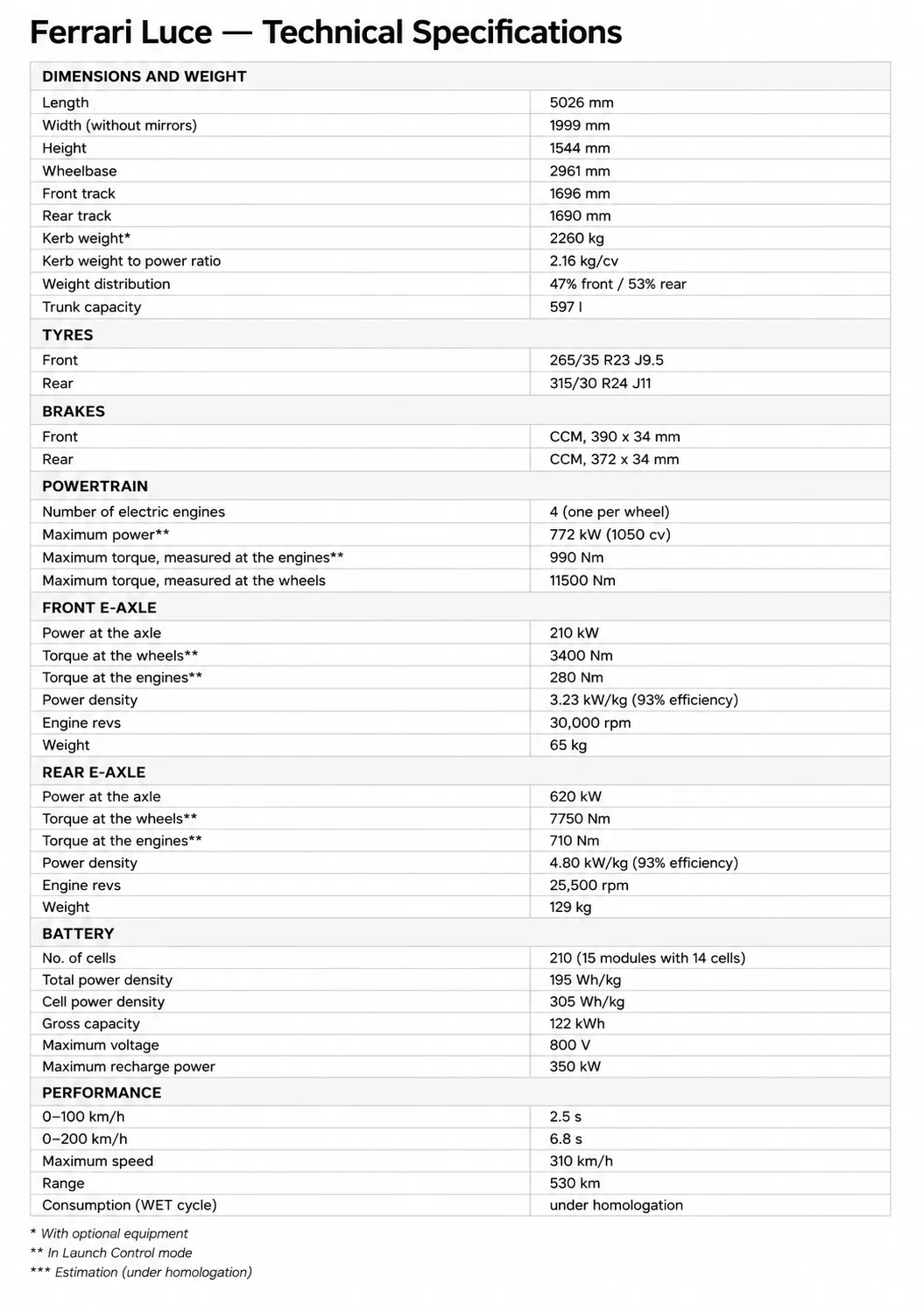
The Luce uses a bespoke EV platform, four electric motors and an 800 V electrical architecture. Each wheel gets its own motor, giving Ferrari far more freedom to control torque, regeneration and vehicle behaviour than it would have with a conventional drivetrain.
Output is rated at 1,050 PS. Ferrari claimed 0-100 kph in 2.5 seconds, 0-200 kph in 6.8 seconds and a top speed of more than 310 kph. Range is quoted at more than 530km, while kerb weight is listed at 2,260 kg. For a large, four-door, five-seat electric Ferrari with a 122 kWh battery, that weight figure is not light in absolute terms, but it is something Ferrari worked hard to contain.

The battery pack was designed, validated and built in Maranello. It uses 210 cells in series, supports DC fast charging at up to 350 kW, and is also part of the car’s structure. Ferrari said the battery housing increases bending rigidity by more than 25% and torsional rigidity by more than 35% compared with previous four-door models.
The EV layout also allowed Ferrari to package the cabin in a way its traditional front-mid engine transaxle layout could not. In the Luce, the battery sits beneath the floor and rear seats, the central tunnel is removed, and the cabin becomes far more open.
Design work was handled with LoveFrom, the design collective led by Sir Jony Ive and Marc Newson, alongside Ferrari Design under Flavio Manzoni.

The result is a clean, very glass-heavy shape with front and rear aerodynamic wings around the main cabin volume. Ferrari said the front and rear light panels are transparent and built into the primary surfaces, while the rear lighting refers to the 360 Modena and 458 Italia.
The Luce also uses unusually large wheels for a Ferrari road car, with 23-inch items at the front and 24-inch wheels at the rear. Ferrari said these are the largest staggered wheel diameters it has used on a series-production road car.
Inside, the Luce does not follow the minimalist EV habit of making one large touchscreen do nearly everything. Ferrari said the interface separates input and output, with essential controls and information placed directly in front of the driver.
Physical buttons, dials, toggles and switches sit alongside multifunction digital displays developed with Samsung Display.

Materials include recycled anodised aluminium, Corning Gorilla Glass and premium leather. The audio system uses 21 speakers, 24 channels and 3,000 W of amplification, with Ferrari Audio Signature adding presets, individual listening optimisation and dynamic compensation.
Sound is one of the more interesting parts of the car. Ferrari did not say it was creating a fake engine note. Instead, the Luce uses a patented in-house system that reads vibration and mechanical texture from the axle through a precision accelerometer.
The signal is filtered, equalised and amplified, rather like an electric guitar. The sound changes according to the e-Manettino setting and paddle use, and is audible inside and outside the car.
Ferrari also claimed the Luce is its most comfortable road car yet. That was helped by active suspension derived from the F80, independent rear-wheel steering and the first elastically mounted rear subframe in Maranello’s history.

Road noise and noise, vibration and harshness were given close attention, which makes sense for a car positioned as a high-performance electric grand tourer rather than a stripped-out EV supercar.
The chassis control systems are just as important as the headline power figure. Each wheel has an actuator for traction and regeneration, one for steering angle and one to control vertical movement.
Ferrari said this lets the car adjust torque distribution in real time according to road conditions and driver demand. The Vehicle Control Unit also debuts on the Luce, integrating powertrain and vehicle dynamics while updating targets 200 times per second.

The paddles have been reworked for electric driving. The right-hand paddle can increase available torque in a progressive way, avoiding the abrupt hit often associated with powerful EVs.
The left paddle increases energy recovery and deceleration. Ferrari’s aim here was clear: make electric acceleration feel controlled and layered, not just violently instant.
Aerodynamics took a large share of the development work. Ferrari said the Luce achieved the lowest drag coefficient in the history of its road cars. Smooth surfacing, active aerodynamic grilles and active ride height all contributed. At speed, the front of the car can drop by 10 mm to improve efficiency.

Ferrari also used recycled secondary-alloy aluminium extensively, saying this reduced CO2e emissions during production of about 70% of the overall vehicle weight.
The Luce is still a gamble, because Ferrari customers do not buy only numbers. They buy noise, texture, ritual and the feeling that the car is doing something special even before it goes fast. Ferrari seems fully aware of that.
The Luce is therefore not just an electric drivetrain wrapped in a famous badge. It is Maranello’s attempt to make an EV behave, sound and respond with enough character to justify the badge on its nose.
Whether it succeeds would depend on the drive. As a first electric Ferrari, the Luce is no cautious experiment. Maranello has gone straight into the deep end.