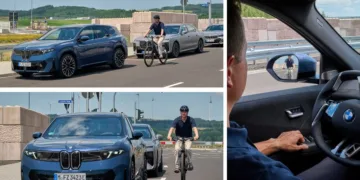





BMW today officially revealed the new i3, the first fully electric 3 Series, and it is plainly one of the brand’s more important launches in years.
As the second “Neue Klasse” model, after the iX3, it does more than add another EV to the line-up. It is BMW’s latest attempt to reset the conversation around its core saloon, while also showing where the brand wants its next generation of cars to go.
The wider commercial angle is that the Neue Klasse sits at the centre of BMW’s effort to recover ground in China, the world’s biggest car market, where European brands have been squeezed by a bruising price war with local players.
Reuters reported BMW sales chief Jochen Goller as saying the market is now showing signs of stabilising, with “in some cases even a price increase”.

Production will start in August. The first version out of the gate would be the BMW i3 50 xDrive. It uses an electric motor on each axle, with total output rated at 345kW/463hp and 645Nm.
BMW said the car uses its sixth-generation eDrive system, 800-volt architecture and new round-cell battery setup. That translates to quicker charging, better efficiency and less compromise on longer trips.
BMW is claiming up to 900km of range on the WLTP cycle, an eye-catching figure by any standard.

Peak DC charging is rated at up to 400kW, and BMW said the i3 can add up to 400km of range in 10 minutes under its stated test conditions.
As always, real-world results will depend heavily on speed, weather, terrain and charging conditions, but in theory the numbers are certainly ambitious.
The i3 is also being used to introduce BMW’s latest cabin and software systems.

It gets Panoramic iDrive and a new control computer called “Heart of Joy”, which BMW said responds 10 times faster than previous systems. That works alongside three other high-performance computers in the Neue Klasse electronics setup.
BMW’s latest assisted-driving suite also arrives under a new name: “Symbiotic Drive”.
In design terms, the i3 still carries familiar 3 Series cues, but the shape is cleaner and more modern.

BMW described it as a 2.5-box saloon, with a long wheelbase, short overhangs, flared wheel arches and a front end that blends the twin-headlight look with a fresh take on the kidney grille.
Inside, BMW said the EV-first layout frees up more cabin room while keeping the driver-focused feel buyers expect from a 3 Series.
The Neue Klasse technology would also be adapted for use in other BMW sub-brands namely Rolls-Royce and MINI. With BMW Alpina becoming a BMW Group brand this year, expect Alpina to work its magic on these models as well.