









China remains the centre of gravity for electric vehicle (EV) demand in November 2025, even as growth cooled.
Benchmark Mineral Intelligence reported that global EV sales reached 2.0 million units for the month, while China’s market grew 3% year-on-year and 4% month-on-month.
The country was still up year-to-date (January to November) with 11.6 million EVs sold, a 19% increase versus the same period in 2024.
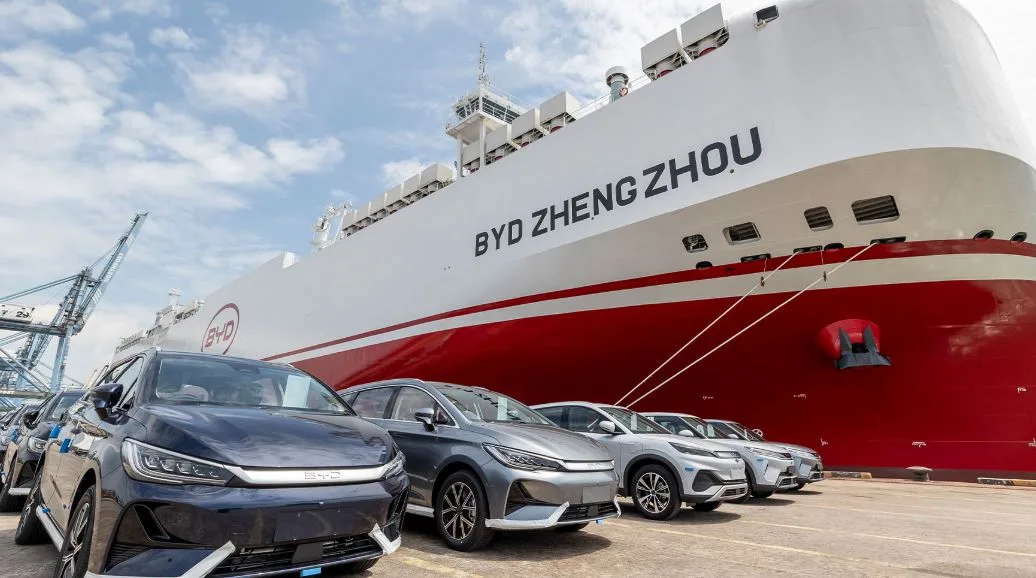
Exports stood out. BYD set a record for reported EV exports at 131,935 units, beating its previous peak of roughly 90,000 units in June 2025.
Benchmark said BYD model sales in Europe rose by more than four times in 2025 to around 200,000 units. It also said sales doubled in Southeast Asia and rose by more than 50% in South America, indicating the widening reach of Chinese brands beyond their home market.
Europe delivered the strongest growth. The region grew 36% year-on-year in November 2025, with battery-electric vehicles (BEVs) up 35% and plug-in hybrids (PHEVs) up 39%. That brought Europe’s year-to-date total to 3.8 million units, growing 33% compared with January to November 2024.
France returned to positive year-to-date territory for the first time in 2025, rising 1% in November, after earlier subsidy cuts weighed on demand.
Benchmark attributed the recovery to major OEMs such as VW Group and Renault, alongside a wider choice of models. It also credited France’s “leasing social” programme, which targeted lower-income households moving into EVs.
Italy recorded just under 25,000 EV sales in November after launching a new incentive programme aimed at replacing older internal combustion engine (ICE) vehicles.
The scheme allocated €597.3 million (around US$700 million) and was intended to replace about 39,000 ICE cars.
The UK also added five EV models that qualified for the full £3,750 subsidy, including the Nissan Leaf (manufactured in Sunderland, with deliveries set to begin in early 2026), the MINI Countryman, Renault 4, Renault 5, and Alpine A290.
In North America, overall EV sales in the United States increased month-on-month in November 2025, after a sharp drop in October following the end of the tax credit on 30 September 2025.
Benchmark also noted that Donald Trump had formally “reset” US Corporate Average Fuel Economy (CAFE) standards in early December, reducing the 2031 fleetwide target to about 34.5mpg versus the previous roughly 50.4mpg target.
It said the looser rules reduced pressure on automakers to transition to BEVs or PHEVs, pointing to ICE-focused investments such as Stellantis’ US$13 billion plan to expand US production by 50%.
“Global EV sales reached 2.0 million units in November 2025, bringing cumulative sales to 18.5 million year-to-date, up 21% on 2024. Europe led growth, rising 36% year-on-year in November, driven by new incentives and wider model availability,” said Rho Motion data manager Charles Lester.
“France and Italy both saw renewed momentum from national support, while the UK expanded its subsidy list to support further uptake. In contrast, North America remained subdued following the end of US tax credits, whereas China continued to dominate with 11.6 million units sold year-to-date, up 19%. Record overseas sales from BYD reflected the growing global reach of Chinese EV makers. Overall, EV demand remained resilient, supported by expanding model ranges and sustained policy incentives worldwide.”
Benchmark Mineral Intelligence provides mine-to-grid battery supply chain intelligence, spanning upstream raw materials through batteries, EVs, charging and energy storage. It acquired downstream intelligence firm Rho Motion in 2024, creating a larger analyst team focused on energy transition supply chains.