


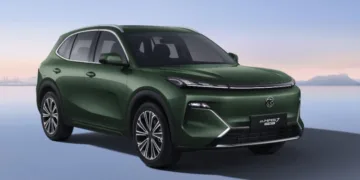



Porsche has revealed the Cayenne Electric, a new battery-powered flagship it describes as a technological milestone and the most powerful production Porsche to date.
The SUV is meant to do the usual Cayenne tricks – carry a family, tow, cross continents – while delivering performance figures that belong in supercar territory.
Two all-wheel-drive models launch the range: Cayenne Electric and Cayenne Turbo Electric.
With Launch Control activated, the Turbo’s dual-motor set-up delivers up to 850 kW (1,156 PS) and 1,500Nm, firing it from 0–100kph in 2.5 seconds and on to 260kph. The standard version is hardly slow either, reaching 100kph in 4.8 seconds and topping out at 230kph.
Porsche depended heavily on know-how from its Formula E programme. The Cayenne Electric can recuperate up to 600 kW under braking, so about 97 per cent of everyday deceleration is handled by the motors alone, with the friction brakes kept in reserve for serious stopping. Ceramic composite discs are optional on the Turbo for drivers who plan to use them.

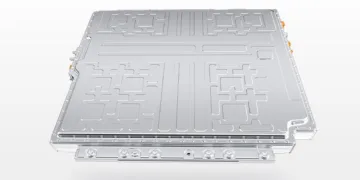
A newly developed 113 kWh battery sits in the floor, cooled from both sides to keep it in its ideal temperature window. On the WLTP test cycle, Porsche quotes up to 642km of range for the Cayenne Electric and up to 623km for the Turbo.
An 800-volt system allows DC charging at up to 390kW, rising to 400 kW in specific conditions, taking the battery from 10 to 80 per cent in under 16 minutes. An inductive set-up will be offered for wireless home charging.
Underneath, adaptive air suspension with Porsche Active Suspension Management is standard on both models. The Turbo also gains Porsche Torque Vectoring Plus and can be specified with the Active Ride system first seen on Porsche’s sports saloons.
Rear-axle steering, available across the range, turns the back wheels by up to five degrees to shrink the turning circle in town and add stability at a cruise.
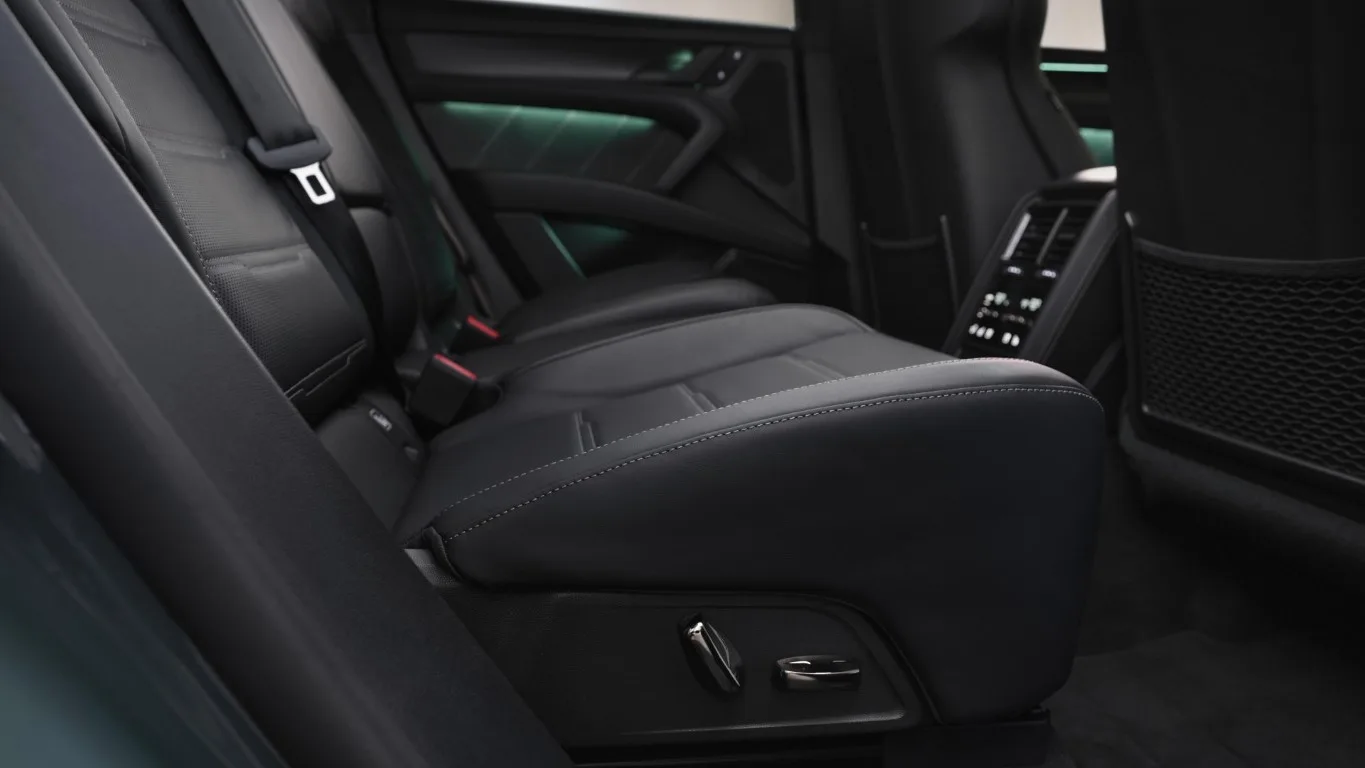
Practicality remains central to the brief. The electric Cayenne is 55 mm longer than the combustion model at 4,985 mm, with a wheelbase stretched by almost 13 cm to 3,023 mm to free up rear legroom.

Boot space runs from 781 to 1,588 litres, backed by a 90-litre front compartment, and towing capacity is up to 3.5 tonnes, depending on specification.
Inside, Porsche has pushed digital tech without abandoning physical controls.
A new curved Flow Display anchors the dashboard and works with a 14.25-inch digital instrument panel and an optional 14.9-inch passenger screen to create the largest display area yet in a Porsche.
An augmented-reality head-up display adds another layer of information, but key functions such as climate and volume still use mechanical switches.
New “Mood Modes” adjust lighting, climate, sound and seat position together, while an electrochromic panoramic roof and panel heating nudge the cabin towards lounge rather than lorry.
The Cayenne Electric joins existing combustion and plug-in hybrid variants in what Porsche calls a three-track strategy extending well into the next decade.
With roughly 36 per cent of its global sales already electrified, the company said the new model is a crucial step towards offering fully electric and combustion powertrains side by side in every major segment it serves.