








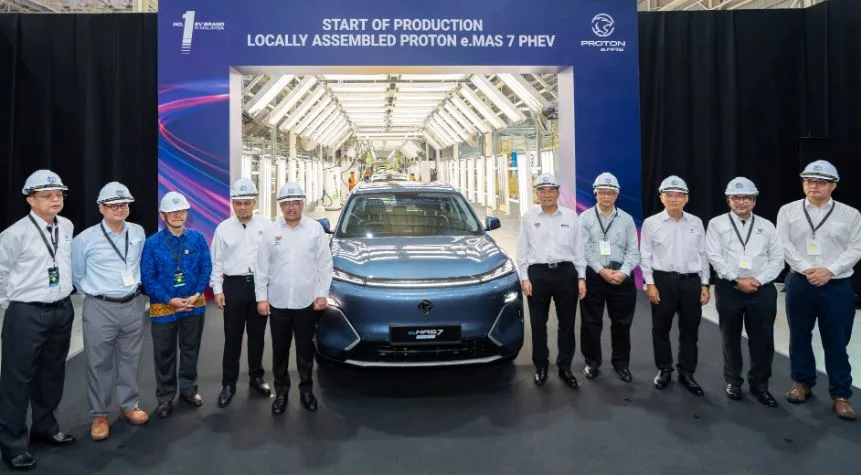
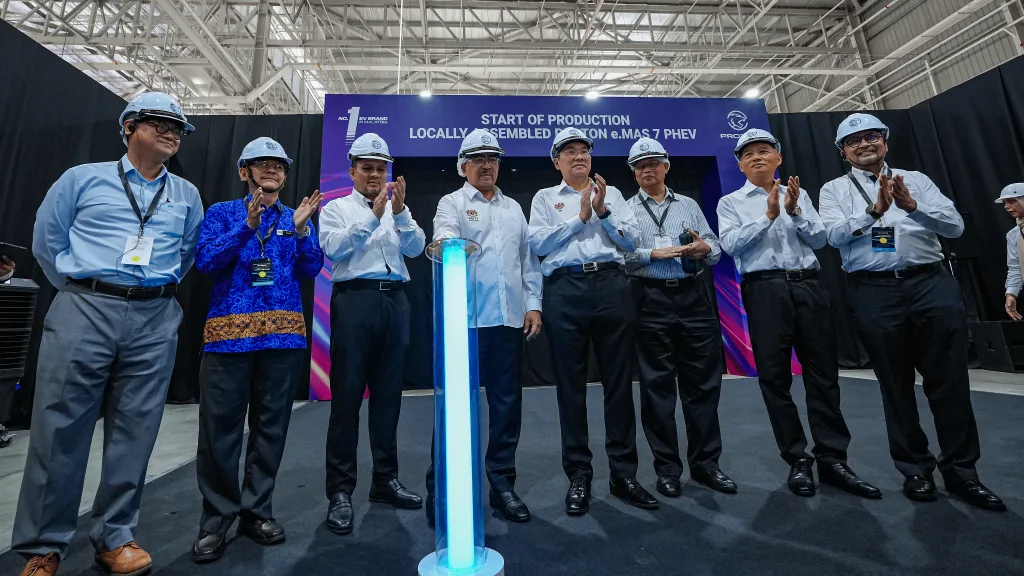
Local assembly of the Proton e.MAS 7 PHEV has started at Proton’s electric vehicle plant in Automotive High-Tech Valley, Tanjong Malim.
The plug-in hybrid is the third Proton e.MAS model to enter completely knocked-down production, meaning all models and variants in the range are now assembled locally. The other locally assembled models are the e.MAS 7 BEV and e.MAS 5.
Pro-NET said 30% of the e.MAS 7 PHEV’s parts are sourced in Malaysia. The programme involves local suppliers across the automotive chain, while the EV plant currently employs 391 people.
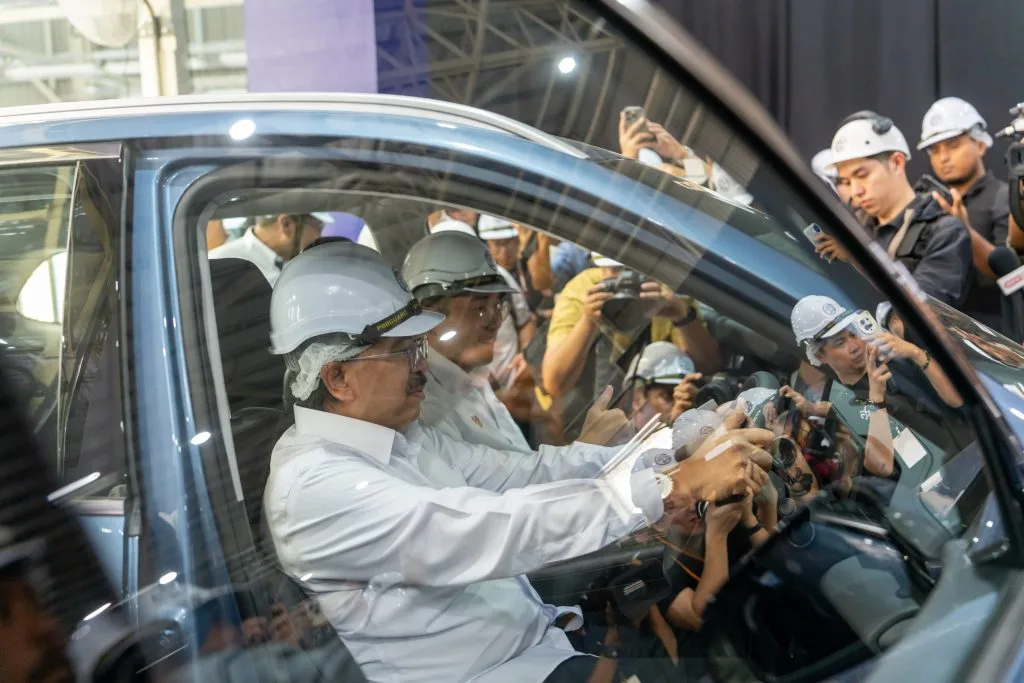
The first locally assembled unit was rolled out at a ceremony attended by Investment, Trade and Industry Minister Datuk Seri Johari Abdul Ghani, his deputy Sim Tze Tzin and Proton management. Guests were shown parts of the production line, including battery-pack installation and final assembly.
Pro-NET described the e.MAS 7 PHEV as Malaysia’s best-selling plug-in hybrid. Year-to-date registrations have passed 4,500 units, while total bookings exceed 11,000.
The start of CKD production comes as Proton prepares to enlarge the Tanjong Malim new-energy vehicle plant. The RM37 million expansion is expected to raise annual capacity to 42,000 vehicles, less than a year after the facility began operating.
The additional capacity is intended to support higher output across the e.MAS range, bring more suppliers into the programme and allow a greater share of components to be sourced locally.
Pro-NET chief executive officer Zhang Qiang said the move reflected the company’s longer-term investment in Malaysian production and suppliers.
Local assembly also brings equipment changes for the Premium and Premium Plus variants. Both now gain front massage seats, adding another comfort feature to the upper versions of the range.
The e.MAS 7 PHEV uses Proton’s EM-i hybrid system, pairing a petrol engine with an electric motor. Pro-NET claims fuel consumption of 4.3 litres per 100 km, an electric-only range of up to 170 km and a combined range of as much as 1,065 km.
DC fast charging, connected-car functions and advanced driver-assistance systems are also included, although exact equipment depends on the variant.
The CKD programme gives Proton greater control over production while increasing the scope for more locally sourced components.
It also places the e.MAS 7 PHEV alongside Proton’s other electrified models at the dedicated Tanjong Malim EV plant rather than relying on imported supply.
Pro-NET said the arrangement would also build local technical skills and create more high-value manufacturing work in Malaysia.