







Mercedes-Benz has struck a multi-year partnership with Liquid AI to bring more embedded, on-device intelligence to models using third- and fourth-generation MBUX in North America, with first production deployment targeted for the second half of 2026.
Mercedes-Benz said the work centres on faster local speech, language understanding and reasoning, rather than pushing more of the experience through the cloud.
The move suggests Mercedes is trying to make its in-car assistant feel quicker and more natural in everyday use.
According to the company, Liquid’s foundation models are designed to run on the hardware already in the vehicle, which should help cut latency and reduce dependence on continuous data exchange with remote servers.
Mercedes said that approach is meant to improve privacy and consistency as well.
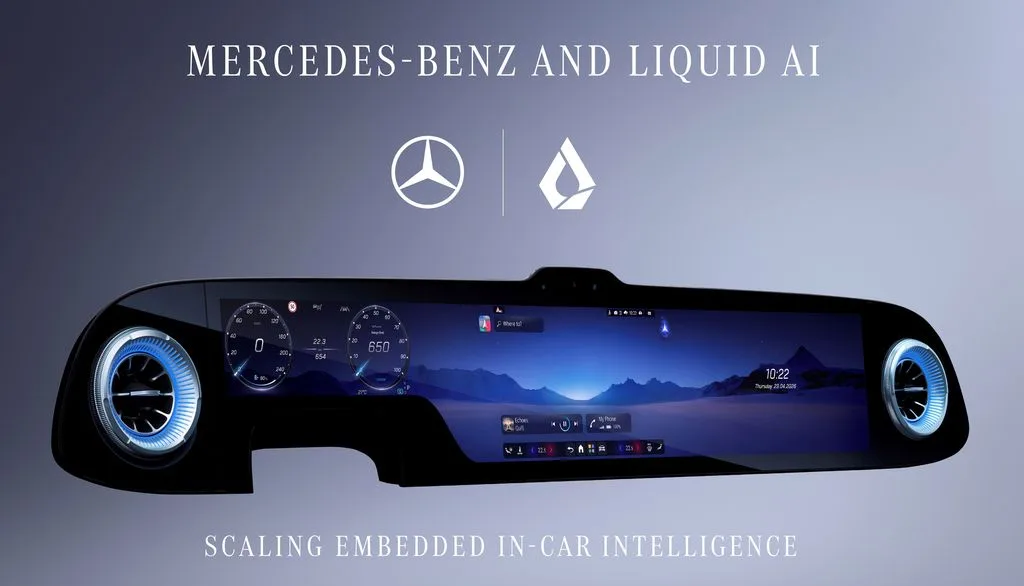
Built on Mercedes-Benz’s MB.OS software architecture, the project is aimed at evolving the MBUX Virtual Assistant by tying together voice control, vehicle functions and contextual understanding in a more capable way. The company said the partnership covers core parts of the in-car voice stack, including speech processing, language understanding and reasoning.
For now, this is a North America plan covering Mercedes-Benz models with third- and fourth-generation MBUX. It also complements, rather than replaces, the brand’s existing cloud-based large language model set-up.
In other words, Mercedes appears to be chasing a hybrid approach: keep some AI tasks in the cloud, but move more of the fast, routine in-car work directly into the vehicle.