



Genesis has unveiled the GV90, its first full-size flagship electric SUV, bringing the 2024 Neolun concept into production with a 123.5kWh battery, about 499km of estimated range and several unusual safety and cabin technologies.
Genesis showed the GV90 on Aug 19 in San Francisco, using the Palace of Fine Arts as the launch venue. It is built on the new Electric Mobility Prime (eMP) platform developed for Genesis flagships.
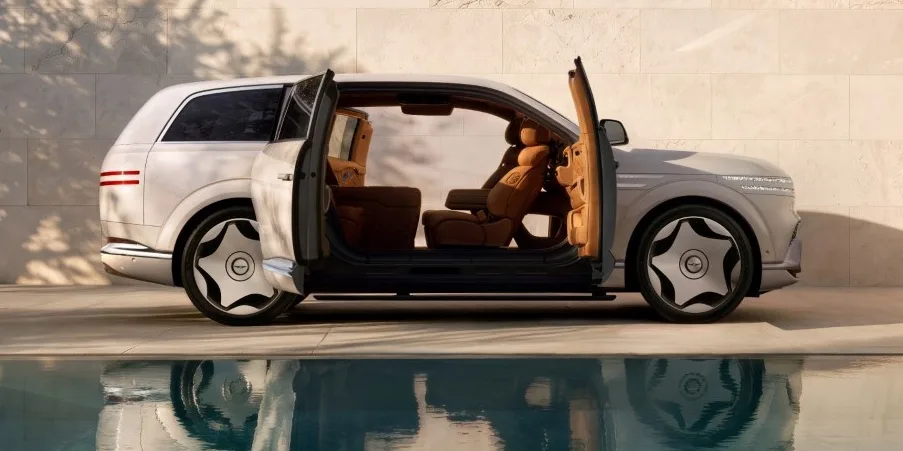
Two versions have been announced. The standard GV90 uses conventional swing doors, while the GV90 Neolun gets the more elaborate Neolun Arch Gate — a B-pillarless coach-door arrangement that Genesis describes as a world first because each front and rear door can operate independently.
The rear doors use a dual-motion hinge. They first move slightly outwards before rotating open, preventing interference with the front doors. With both doors open, there is no fixed B-pillar dividing the opening.
Removing that pillar required substantial structural work. Genesis says high-strength dual steel beams take over part of the load-bearing role, while the passenger compartment incorporates high-strength steel tubes, structural foam and what the company calls a concealed roll cage. The surrounding frame is 1.5 times thicker than on conventional vehicles, according to Genesis.
The GV90 carries 12 airbags, including a roof airbag that Genesis calls a world first. During a severe rollover, it deploys across the glass roof to reduce the risk of occupants being ejected or striking the roof.
The restraint system also includes seat-cushion airbags intended to reduce submarining beneath the seatbelt, extended curtain airbags covering the third row and larger side airbags for the first two rows. The front passenger airbag can deploy in two stages depending on occupant posture. An in-cabin monitoring system identifies occupant type and seating position so airbag and seatbelt operation can be adjusted accordingly.
Genesis has also built extra protection around the battery. Ultra-high-strength steel is used around the body sides, while a slider structure ahead of the battery is intended to send the motor and subframe downwards in a frontal impact instead of into the pack.
Thermal Runaway Protection is designed to limit heat propagation between cells, backed by a cloud-connected battery management system that monitors for abnormalities. The underbody uses cast and extruded aluminium, with aluminium also employed extensively for exterior panels.
The 123.5kWh battery is the largest fitted to a Hyundai Motor Group EV to date. A Wireless Battery Management System is also used to improve packaging efficiency.
Genesis estimates the seven-seat GV90 can travel about 499km on a charge, based on its own testing. A 350kW DC charger can take the battery from 10 to 80% in a claimed 22 minutes.
Dual motors produce a combined 490kW and about 800Nm, making this the most powerful electric powertrain yet announced by Hyundai Motor Group.
It is also the group’s first vehicle with electronic limited-slip differentials on both axles. The system can vary torque distribution across all four wheels, helping to control wheelspin on slippery surfaces and manage power during faster cornering.
A multi-chamber air suspension varies spring stiffness and ride height, working with electronically controlled dampers. Rear-wheel steering gives the back wheels as much as five degrees of steering angle, tightening low-speed turns and adding stability at higher speeds.
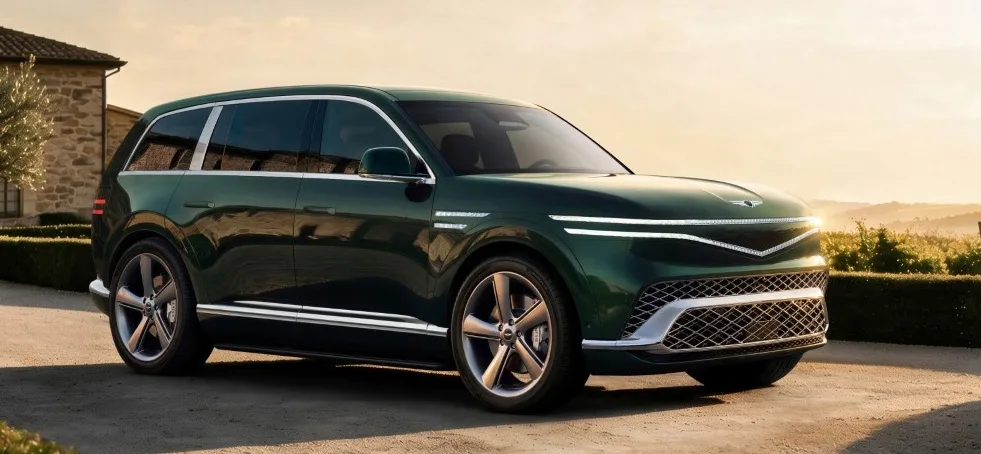
The GV90 measures 5,285mm long and rides on a 3,246mm wheelbase, with 24-inch forged wheels available. Its shape closely follows the Neolun concept, including the broad front lighting treatment, smooth body surfaces and a rear end with no conventional spoiler. Genesis says the exterior takes inspiration from traditional Korean moon jars.
The Neolun’s cabin retains another concept-car idea. When parked, its front seats can rotate through 180 degrees so their occupants can face those in the rear.
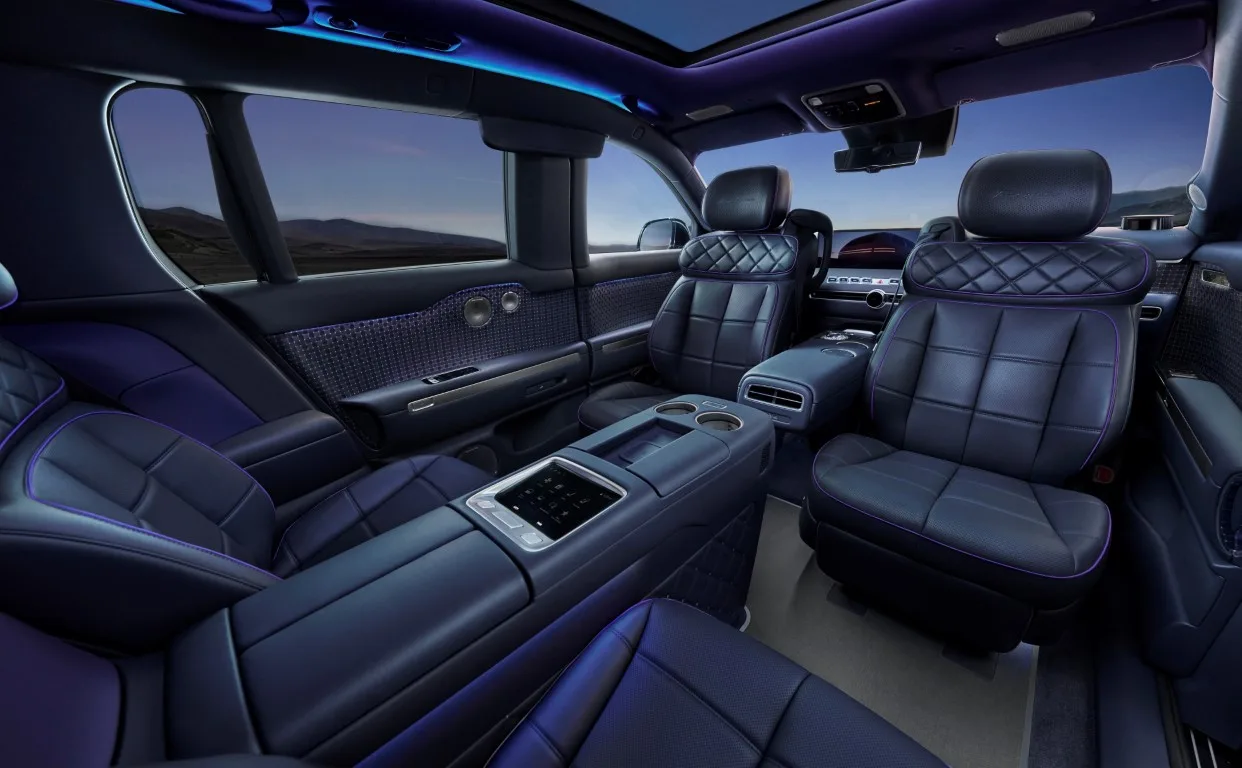
The four-seat Neolun Executive Suite goes further. It adds a real-wood veneer floor, radiant floor heating inspired by Korea’s traditional ondol system, a partition between the passenger compartment and luggage area, electrically operated privacy blinds, a refrigerator and integrated rear tables.
Above is the Smart Vision Roof, which uses polymer-dispersed liquid crystal film to vary transparency independently across six sections. A metal-coated heated windscreen can clear frost and condensation by heating the glass itself, with additional radiant heaters built into parts of the armrests, doors and cabin side panels.
The dashboard uses a movable OLED screen. A 23.6-inch display sits in its normal position while driving. When parked, it can rise by 90mm and expand its visible area into a 24.6-inch format for media viewing. A 25-inch head-up display handles key driving information.
There is no conventional start button. Opening the vehicle powers its systems, while closing the door causes the column-mounted shifter to move into its operating position. Pressing the brake pedal then makes the GV90 ready to drive.
Infotainment runs on Hyundai Motor Group’s Pleos Connect platform, based on Android Automotive OS, with downloadable third-party apps and the group’s Gleo generative-AI voice assistant. Remote Smart Parking Assist 3 and Memory Reversing Assist are also among the announced driver-assistance functions.
A 25-speaker Bang & Olufsen Premier 3D system with Dolby Atmos handles audio, while seats use 15 individual air cells for massage functions. Buyers will have 16 exterior colours and several interior combinations using leather, natural wood, genuine stone and wool-cashmere trim.
Genesis also revealed a limited GV90 Neolun First Edition based on the four-seat Executive Suite, distinguished by two-tone paint, body-coloured 24-inch wheels, wool-cashmere cabin trim and model-specific detailing.
Pricing, launch markets and delivery timing have yet to be disclosed.