





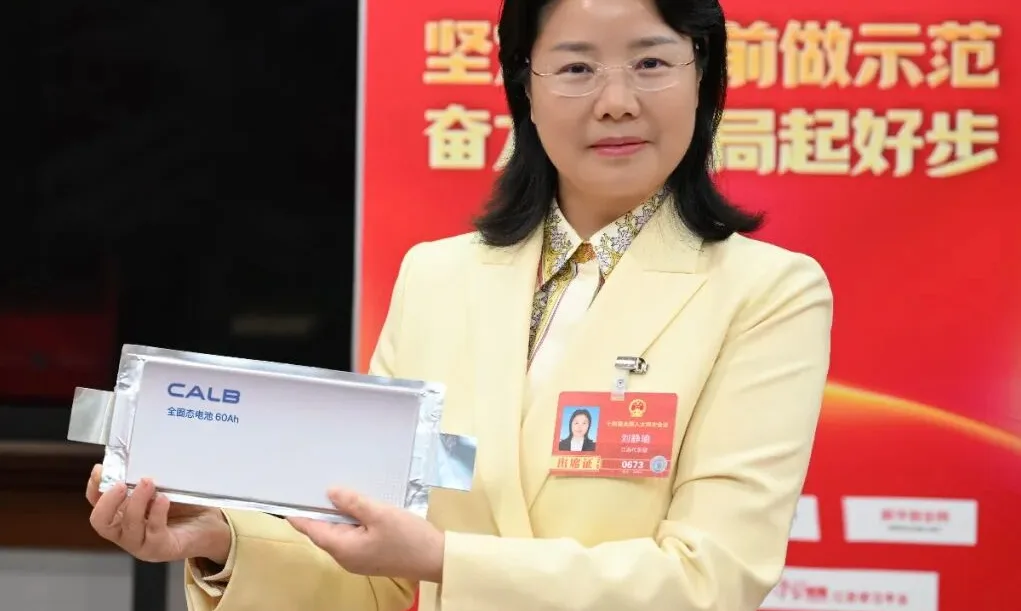
Chinese battery maker CALB has used China’s “Two Sessions” political meetings to show off a 60Ah automotive-grade all-solid-state battery that it says could support electric-car driving range of more than 1,000km.
According to Sina, the cell is claimed to deliver energy density above 450Wh/kg, which would put it well beyond today’s mainstream EV batteries if the figure holds up in real-world automotive use.
The Sina report quoted CALB chairwoman Liu Jingyu as saying the battery marked a new step in safety and energy density.
CALB also said it has already built what it describes as an industry-leading vehicle solid-state battery production line and completed initial trial production validation of a 450Wh/kg all-solid-state system.
Sina reported that CALB’s nearer-term rollout does not begin with passenger cars. The company said it completed development in 2025 of solid-state batteries for robots and aircraft with energy density above 450Wh/kg, and plans to deliver them in volume for about 1,000 robot-level products in the fourth quarter of 2026.
For passenger cars, CALB is separately developing its “Wujie” all-solid-state battery with a stated target of 430Wh/kg, with vehicle installation planned for 2027.
That pecking order is revealing. It suggests CALB is still taking the usual path of putting expensive, high-performance cells into niche applications first, before trying to scale them for cars where cost, durability and manufacturability matter just as much as energy density.
Sina itself noted that solid-state batteries still face big hurdles in cost and production processes. It cited semi-solid battery cell costs at about 0.85 yuan per Wh, versus below 0.4 yuan per Wh for conventional liquid lithium batteries, with large-scale commercialisation only expected after 2030.
Sina said solid-state development is now spreading across sulphide, oxide and polymer or halide routes, with Chinese firms taking multiple approaches and pushing hard into commercialisation.
That is broadly credible. What is less certain is timing. A lab cell, or even a pilot-line cell, is not the same thing as a battery pack that can survive years of heat, vibration, charging abuse and warranty risk in an ordinary road car.
While the CALB battery is notable, it looks more like a sign of intent than a sign that solid-state EVs are about to flood showrooms.
Commercial delivery at scale has yet to take off.