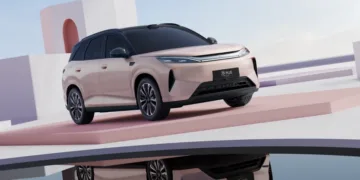





Volkswagen Group China said it has delivered its new China Electronic Architecture (CEA) on schedule, a key step in getting its first CEA-based production model, the VW ID. UNYX 07, rolling out of the Volkswagen Anhui plant.
The group billed the launch as its entry into full-cycle software-defined vehicle (SDV) development and series production “in China, for China”, with the CEA forming the backbone for a new wave of “intelligent connected vehicles”.
It added that four more models from its Volkswagen brand joint ventures will follow with the same underlying architecture.
So what changes with CEA? In simple terms, Volkswagen moved to a zonal electronic/electrical (E/E) architecture built around high-performance central computing, designed to be scalable and continuously upgradable through the vehicle’s life.
Volkswagen Group China said it plans to deploy this zonal setup across multiple platforms and powertrain types, spanning EVs, hybrids and combustion-engine vehicles produced locally.
Volkswagen claimed the shift also trims hardware clutter. Compared with earlier generations, it said the CEA reduces the number of electronic control units (ECUs) by about 30%, cutting complexity and creating a more stable base for features such as AI-based cockpit functions, China-specific driver assistance systems, and full-vehicle over-the-air (OTA) updates.
The architecture was developed by Volkswagen Group China Technology Company (VCTC) together with CARIAD China and Xpeng, a tie-up Volkswagen has previously positioned as central to speeding up local software and E/E development.
On the business side, Volkswagen said the new development approach could shorten overall vehicle development cycles by up to 30%. It also claimed that stronger localisation and earlier supplier integration can cut development costs by up to 50% in selected key projects.
Volkswagen Group CEO Oliver Blume said the project reached series production in 18 months, calling it a milestone for the company’s China strategy and software ambitions.
China chief Ralf Brandstätter said the CEA should help Volkswagen bring software-driven innovation to market at “competitive cost and speed” while keeping “Volkswagen DNA” intact.
Volkswagen stressed that while delivery timing was compressed, its validation cycle remained unchanged, pointing to the quality and reliability expectations it said it has built with more than 50 million customers in China over four decades.